
COSC and Chronometer Certification: What It Actually Means
The word 'chronometer' gets stamped on dials, printed on rotors, and dropped into sales conversations like it settles the argument. It does mean something specific, but it means less than some people assume and more than others give it credit for. Here is what the label actually certifies, and where it stops.
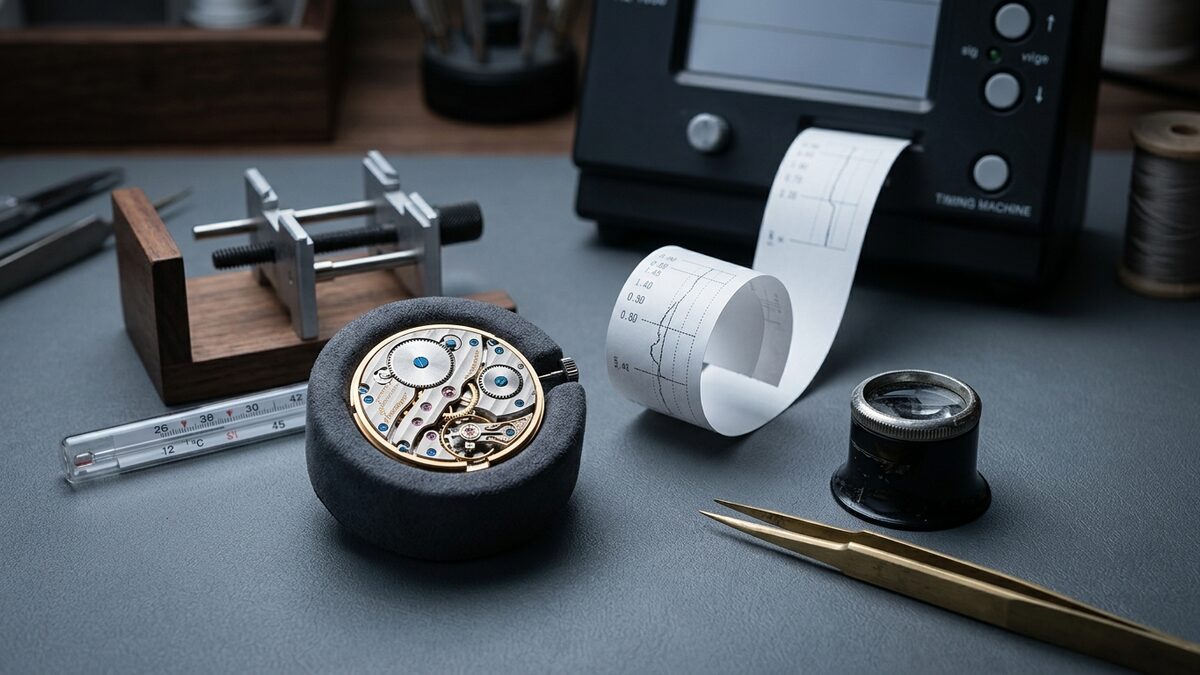
Start with the thing most enthusiasts get slightly wrong: 'chronometer' is not a marketing word, and it is not the same as 'chronograph'. A chronograph is a watch with a stopwatch complication. A chronometer is a movement that has passed an independent precision test. Plenty of watches are both, plenty are neither, and the two words share a Greek root and nothing else useful.
The most common certifying body is COSC, the Contrôle Officiel Suisse des Chronomètres, a Swiss non-profit that tests movements against an international standard. When a brand sends movements to COSC, each one is run through a fixed protocol before it ever reaches a case. If it passes, the brand earns the right to call that movement a certified chronometer. If it fails, it either gets regulated again or quietly sold as a standard movement. The testing happens at the movement level, which is a detail worth holding onto.
What the COSC chronometer test actually measures
COSC runs each movement for 15 days, in five positions, at three temperatures. The headline number everyone quotes is the average daily rate, which must fall between -4 and +6 seconds per day. That asymmetry is deliberate: a watch that runs slightly fast is generally preferred to one that lags, so the tolerance leans positive.
But the average rate is only one of seven criteria. COSC also checks mean variation across positions, the greatest single positional variation, the effect of temperature swings, and rate resumption after the movement has been through its paces. A movement can hit a beautiful average and still fail if it is inconsistent between the dial-up and crown-down positions. That is the part casual buyers miss. Certification is not just 'accurate on average', it is 'consistent under a range of conditions', which is a much more useful promise for something you actually wear.
Here is the honest caveat, though. COSC tests the bare movement, not the finished watch. Once that movement is cased up, fitted with hands, and handed to you, real-world performance depends on the case, the wearer's habits, magnetism, shocks, and how the watch is stored overnight. A certified movement gives you a strong starting point, not a lifetime guarantee. A well-regulated non-certified watch worn thoughtfully can absolutely outperform a certified one that lives face-down next to a laptop speaker.
If you want to sanity-check your own watch, time it against a trusted reference over several days in the positions you actually use, rather than judging it off a single overnight reading. Consistency tells you more than any one number.
METAS, Master Chronometer, and why in-house standards changed the conversation
COSC held the spotlight for decades, and then the goalposts moved. Some brands decided the movement-only test was not demanding enough for how people use modern watches, especially around magnetism, which is everywhere now thanks to phones, tablets, and cabinet latches.
The most cited response is the Master Chronometer certification, administered by METAS, the Swiss federal metrology institute. The crucial difference is that METAS tests the fully cased watch, not just the movement, and it does so after the watch has already passed COSC. It layers a second, tougher standard on top of the first. The METAS protocol includes resistance to magnetic fields up to 15,000 gauss, a tighter daily-rate window of 0 to +5 seconds per day measured on the assembled watch, plus checks on power reserve and water resistance. It is a whole-watch promise rather than a bare-movement one.
Other brands run their own in-house programs with names that vary and standards that are sometimes stricter than COSC, sometimes just differently marketed. This is where a buyer has to read carefully. An in-house 'chronometer-grade' claim is only as trustworthy as the transparency behind it. Independent, published standards like COSC and METAS are verifiable. A vague in-house badge with no numbers attached is asking you to take it on faith, and faith is not a spec.
So how much should any of this weigh in a purchase? Sensibly, but not obsessively. Certification affects two real things. First, accuracy expectations: a certified piece should hold tighter tolerances out of the box, which matters if you actually care about running within a few seconds a day. Second, the resale conversation: certification is a documented, third-party fact, and documented facts help a watch hold value and make secondhand negotiations cleaner. A certified reference with its papers is simply easier to talk about than one without.
What certification does not tell you is whether the watch is good. It says nothing about finishing, proportions, bracelet comfort, dial quality, or whether the thing makes you happy to strap it on. Some of the most beloved movements in the hobby were never certified, and some certified movements sit inside watches nobody loves. Treat the chronometer label as one line on the spec sheet, a genuinely useful one, next to the lines about material, water resistance, and service intervals.
If you are shopping and comparing two similar watches, a practical way to weigh certification: ask what standard was used, whether it is independently verifiable, and whether it was tested at the movement or the cased-watch level. Those three answers tell you far more than the word 'chronometer' printed on a dial ever will. Then go handle both watches, because the one you keep reaching for is the one you should buy.