
Power Reserve Explained: What It Means and Why It Varies
Power reserve is one of those spec-sheet numbers that sounds technical but actually describes something delightfully simple: how long your watch keeps running after you stop winding it or take it off. If you have ever picked up a mechanical watch on Saturday morning and found it dead and frozen at some random time, you have already met the power reserve, or rather the moment it ran out.
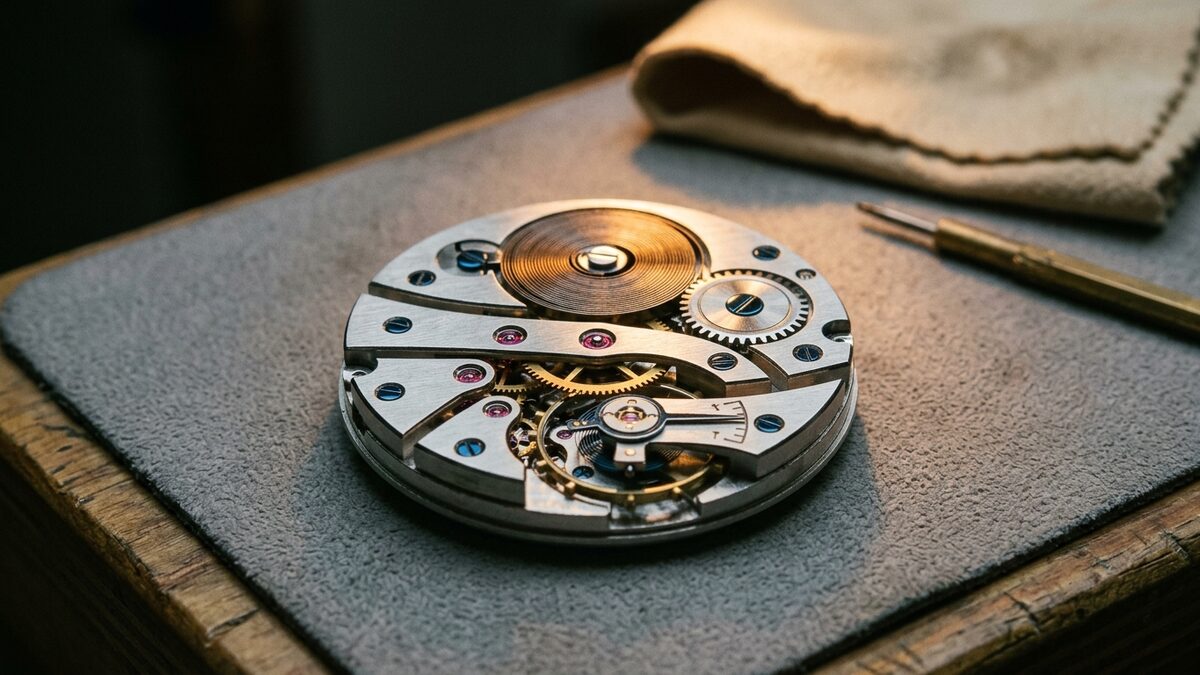
Every mechanical watch stores energy in a coiled strip of springy metal called the mainspring. Winding the crown, or in an automatic the motion of your wrist swinging a rotor, tightens that spring. As it slowly unwinds, it feeds a steady trickle of energy through the gear train to the balance wheel, the little oscillating heart that keeps time. The power reserve is simply how many hours the mainspring can keep that trickle going from fully wound to fully spent.
Manufacturers usually quote it as a range or a round figure: 38 hours, 42 hours, 70 hours, 80 hours and beyond. That single number tells you a surprising amount about how a watch will fit into your week, so it is worth understanding what pushes it up or down.
The honest headline is that there is no single best power reserve. A dressy piece you wear daily and a weekend watch you rotate in and out of a collection have very different needs. The number only matters in the context of how you actually live with the watch.
Why some watches run 38 hours and others go past 80
The classic figure for a long time was roughly 38 to 44 hours, and plenty of excellent movements still land right there. That range is basically enough to cover a full day of wear plus one night off the wrist. Take the watch off Friday evening and it will likely still be ticking Saturday afternoon, but by Sunday morning it may have stopped. Nothing is wrong with a movement like that; it was engineered around the assumption that you wear it most days.
Longer reserves, the 70 to 80-plus hour club, come from a few design choices. The most common is a larger or longer mainspring, sometimes a single big barrel and sometimes two barrels working together to store more energy. Some brands also run the balance at a slightly lower frequency, which sips energy more gently and stretches the same charge over more hours. Better mainspring alloys and lower-friction escapements help too, squeezing more running time out of the energy already stored.
The reason the industry drifted toward longer reserves is partly practical and partly cultural. As people started owning more than one watch, the old daily-wear assumption stopped holding. A movement that survives a full weekend off the wrist and is still running, and still accurate, on Monday morning is genuinely more pleasant to own. An 80-hour reserve means you can wear something else all weekend and your watch is ready to go without a reset.
There is a small trade-off worth knowing. A watch does not keep perfect time all the way to the last drop. As the mainspring winds down toward empty, the power delivered to the balance drops, and timekeeping can drift in those final hours. This is why many enthusiasts top up an automatic with a few manual turns of the crown if it has been sitting, keeping it in the healthy middle of its reserve rather than running it to exhaustion.
What the number means for rotating a small collection
Here is where power reserve stops being trivia and starts being genuinely useful buying knowledge. If you own one watch and wear it every day, the reserve almost does not matter, because your wrist keeps an automatic topped up and a manual watch just needs a daily wind. The habit does the work for you.
The picture changes the moment you own two or three watches and rotate between them. Say you wear watch A on Monday and Tuesday, switch to watch B on Wednesday and Thursday, then come back to A on Friday. A 38-hour movement in watch A will be stone dead by the time you reach for it again, meaning a full reset of time and date every single time you rotate. A 70 or 80-hour movement, by contrast, might still be alive and correct after two or three days on the shelf. For a rotating collection, a longer reserve is quietly one of the most convenient features you can buy.
If you love the idea of grab-and-go convenience across several pieces, a watch winder is the other common answer, keeping automatics wound while they rest. Plenty of collectors prefer the winder route; plenty of others enjoy the little ritual of setting a watch when they pick it up. Neither is wrong. Knowing the reserve figure just lets you choose the setup that suits you instead of being surprised by it.
A few practical things to check before you buy, framed the way a real buyer would ask them. First, is the quoted reserve for a fully wound movement, which is the standard, so you can plan around a realistic worst case. Second, does the watch have a power reserve indicator on the dial or caseback; some people find that little gauge genuinely handy, others find it visual clutter. Third, if you are choosing between two similar watches at a similar price, a meaningfully longer reserve can be the tiebreaker for a rotation-heavy owner, while a daily-wearer can happily ignore it in favor of dial, case, or bracelet.
Does a bigger power reserve hold value better? Not directly. Resale is driven far more by brand, model, condition, and demand than by hours of running time. What a long reserve does buy you is day-to-day pleasure, and that is a perfectly good reason to care about it.
So the next time you read a spec sheet, treat the power reserve as a lifestyle hint rather than a bragging right. A short reserve says wear me often. A long one says take your time, I will be here when you come back. Match that personality to how you actually wear watches, and the number finally means something.