
Service History: Why It Matters for Watch Value
A mechanical watch is a small machine that wants attention every few years. The paperwork that proves it got that attention is worth more than most sellers realize, and the gaps in that paperwork are worth a lot less than most sellers hope.
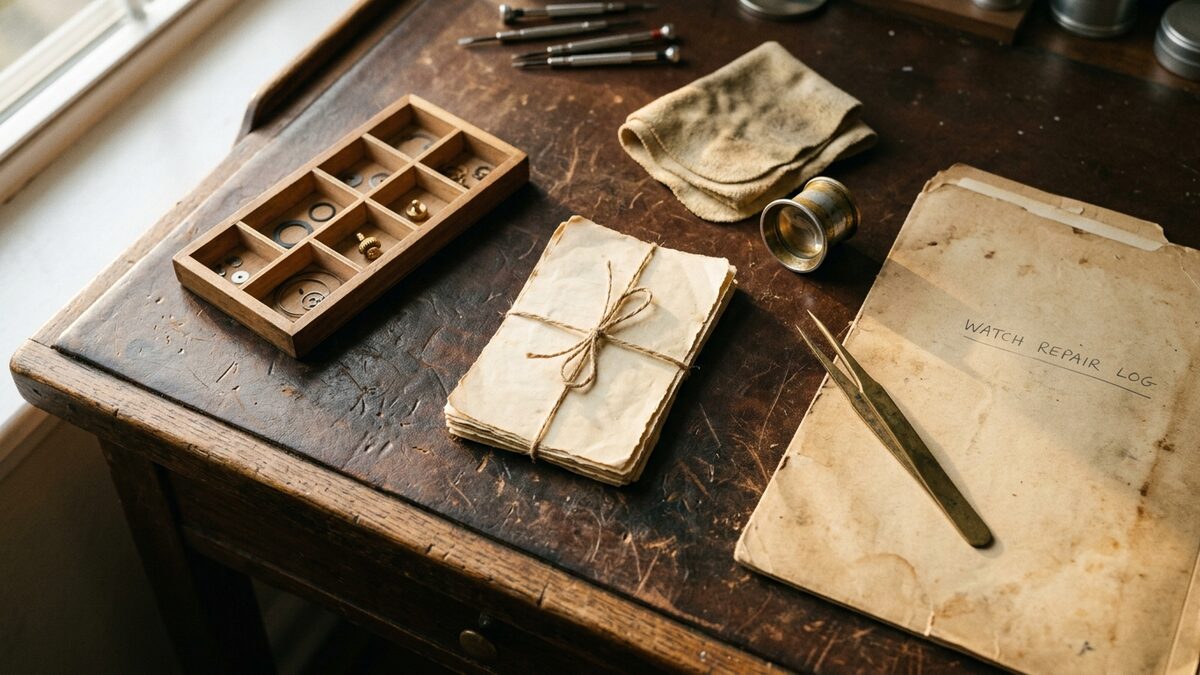
Walk into any serious watch shop with something to sell, and the second question after "what is it" is almost always "do you have the service history?" Not the box, not the warranty card, not even the original receipt. The service records. There is a reason buyers ask in that order, and it has very little to do with sentiment.
A watch that runs is not the same as a watch that has been kept up. Movements accumulate wear in ways that are invisible from the dial side. Mainsprings fatigue, lubricants dry out, pivots score their jewels, and gaskets harden until water resistance is theoretical. None of this announces itself. A piece can keep respectable time for years past its service interval and then surprise its owner with a repair bill that exceeds what a fresh service would have cost two or three times over. Buyers know this. The ones writing the bigger checks have lived it.
What documentation actually proves, and what it doesn't
A service invoice is a paper trail of three things: who touched the movement, what they did, and roughly when. That is more useful than it sounds. It tells a prospective buyer that the watch was opened by someone willing to put their name on the work, that specific parts were replaced or cleaned, and that the timing of those interventions lines up with a plausible ownership history. None of that guarantees the watch is perfect today, but it shifts the risk calculation in a meaningful way.
What documentation does not prove is condition right now. A full service from a respected watchmaker three years ago is reassuring, but it is not a current bill of health. Buyers who care about service history also tend to care about recency, and the value premium decays the further out the last service sits. Inside roughly five years of a major overhaul, the paperwork carries close to full weight. Past that, it functions more as evidence of long-term care than as a guarantee of present condition.
The watchmaker's reputation matters too. A service performed by the manufacturer carries more weight than one performed by an independent, and an invoice from a well-regarded independent carries more weight than a receipt from a mall jeweler. This is not snobbery. It reflects how much a buyer is willing to assume about parts sourcing, technical competence, and the likelihood that whatever was done will hold up.
The paperwork buyers want to see
Most buyers are looking for a short, consistent list of items. A dated invoice from the servicing watchmaker, listing the watch by reference and serial number. A description of the work performed, ideally including what was replaced versus what was cleaned and lubricated. A pressure test result if the watch carries a water resistance rating. Any parts that were swapped out, particularly if the original components were returned with the watch.
Crown and pendant tubes, gaskets, mainsprings, and crystals are the everyday consumables, and buyers expect to see them on a service invoice. Hands, dials, and bezels are not consumables, and any work involving them should be flagged explicitly. A watch that has had a dial refinish or aftermarket hands without disclosure is a watch that will lose value the moment a buyer notices, and serious buyers always notice.
Original purchase paperwork, while not strictly service history, often travels with it and adds context. A first-owner card with a dated activation, paired with a single service invoice from the manufacturer ten years later, tells a clean story. The market rewards clean stories.
Handling gaps without overselling
Most watches that come through the secondary market have incomplete records. This is not a fatal flaw, but it is worth handling honestly. A watch with no service paperwork is not worthless; it is a watch that the next buyer will price assuming a service is needed soon. That assumption is usually correct, and arguing against it tends to make sellers look either uninformed or evasive.
The cleanest move when records are missing is to commission a current service before listing. The cost is real, but on watches above a certain value tier, the math often works out. A fresh, documented service from a credible watchmaker resets the clock for the next owner and removes the largest unknown from their decision. On lower-tier pieces, the math rarely works, and disclosure plus a realistic price is the better path.
If a service was performed but the paperwork is lost, that is worth saying out loud. "Serviced approximately four years ago by a local independent, invoice no longer available" is a candid description. It will not command the same premium as a documented service, but it is more credible than silence, and credibility tends to translate into faster sales at fairer prices.
What this means at appraisal time
Anyone preparing a watch for sale or insurance valuation should treat service records the same way they treat the watch itself: gather everything, organize it chronologically, and present it without embellishment. A folder with the original card, any service invoices, and a current condition photo is a five-minute project that consistently improves outcomes. Appraisers and buyers are looking for reasons to trust the seller, and a tidy paper trail provides several of them at once.
The watches that sell quickest and closest to asking are almost never the ones with the rarest references or the most pristine cases. They are the ones whose stories check out on the second read.