
Understanding Watch Movement Types: Quartz, Automatic, and Manual
Few decisions shape how a watch fits into your life more than the movement ticking away inside it. The category sounds technical, but it really comes down to three questions: how accurate does it need to be, how often are you willing to service it, and how much do you want to participate in keeping it running? Quartz, automatic, and manual answer those questions in very different ways.
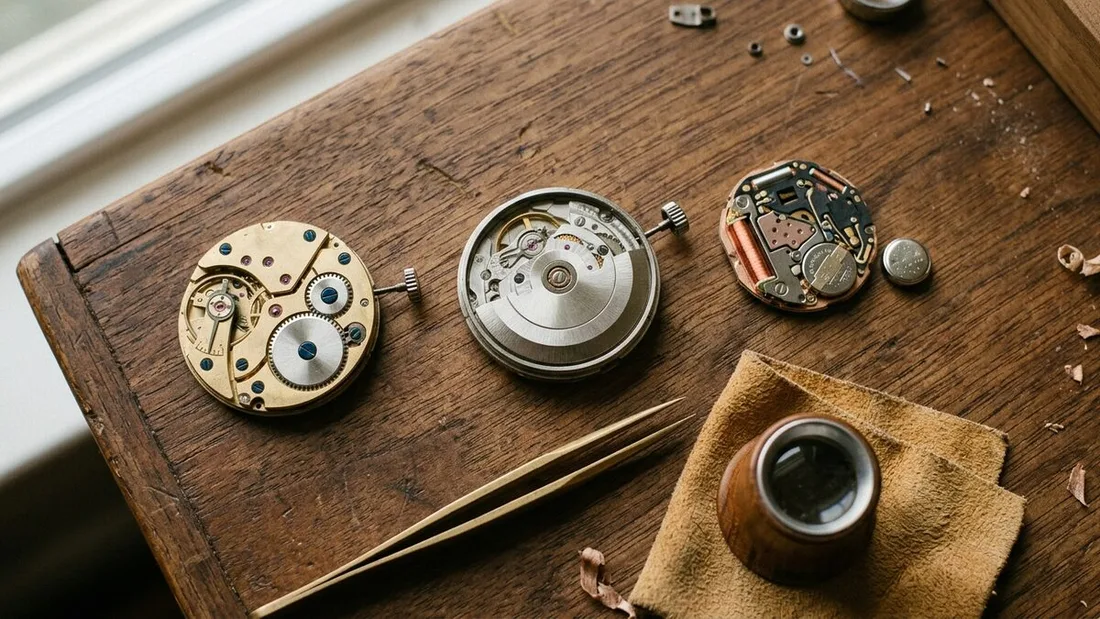
Most first serious watch purchases get framed around the dial, the case, and the bracelet. Those are the parts you see across a room. The movement is the part you live with, and the difference between living with a quartz module and living with a hand-wound caliber is genuine. None of the three options is better than the others in any absolute sense. They are different choices for different temperaments and different wrist habits.
Before sorting through them, a quick vocabulary check is useful. A movement, sometimes called a caliber, is the engine of a watch. It keeps time, drives the hands, and powers any complications such as a date wheel or chronograph. Movements split into two big families: mechanical and electronic. Mechanical movements run on a wound mainspring and a balance wheel oscillating at a fixed frequency. Electronic movements run on a battery and a quartz crystal vibrating at thirty-two kilohertz. Inside the mechanical family, automatics wind themselves through the motion of your wrist, and manuals ask you to wind them yourself.
How Quartz, Automatic, and Manual Movements Actually Differ in Daily Use
Quartz wins on accuracy by a wide margin. A standard quartz movement typically holds within fifteen seconds per month, and high-grade thermocompensated versions stay within a few seconds per year. Mechanical movements run somewhere between negative four and positive six seconds per day if they meet chronometer standards, and many uncertified mechanicals drift further than that. If you set a watch and forget about it for weeks at a time, quartz is the most forgiving choice you can make.
Automatic movements occupy the middle ground. They wind from the natural motion of your wrist through an oscillating rotor, so a watch you wear daily stays running on its own without any input. Skip a few days, and it stops, then needs a brief wind and a reset of the time. Many collectors solve that gap with watch winders, though winders introduce their own debate among purists who feel a watch should rest when you do. Automatics are also the heaviest of the three categories because of the rotor, and that rotor adds a faint whirring sound that you either find charming or never notice at all.
Manual movements ask the most of you and give the most back, depending on your perspective. You wind the crown every morning or every other day, depending on the power reserve. Twenty to thirty turns is typical for a fully unwound mainspring. The ritual is small but real, and many enthusiasts describe it as the moment a watch goes from being an object to being a relationship. Manuals also tend to be the thinnest mechanical option since there is no rotor stacked above the gear train, which matters quite a bit if you like a watch that disappears under a shirt cuff.
Service intervals separate the categories further. A quartz watch usually needs a battery every two to three years and a full service maybe once a decade. A well-made mechanical movement, automatic or manual, wants a full service every five to seven years, which involves complete disassembly, ultrasonic cleaning, fresh lubrication, regulation, and reassembly. That service is not cheap, and the cost scales with the complexity of the watch. Budget for it before you buy, not after.
Choosing Based on How You Actually Wear a Watch
The honest question is not which movement is best, but which one matches your habits. If you rotate through five watches and want any of them ready when you grab it on the way out the door, quartz pieces and mechanicals with very long power reserves earn their keep. If you wear one watch nearly every day and like the idea of it being part of a routine, an automatic is hard to argue with. If you have a small collection, enjoy hands-on rituals, and want a movement you can appreciate through a display caseback, a manual rewards that kind of attention better than anything else.
Resale behavior is worth a word too. Mechanical watches from established makers generally hold value better than quartz pieces over the long run, with some notable exceptions for vintage quartz from the late seventies and early eighties that has developed a devoted collector following. That said, buying a watch primarily as an investment tends to disappoint. Buy what you actually want to wear on your wrist. The market will do what the market does, and the only return you can reliably count on is the one you get from enjoying the thing daily.
One last consideration is repairability over decades. A simple manual movement from a mainstream Swiss or Japanese maker can almost always be serviced fifty years from now because parts, schematics, and trained watchmakers remain available. Highly complex automatics and proprietary quartz modules can become orphaned when manufacturers discontinue components or close the books on legacy calibers. If you are thinking generationally, perhaps about a watch you want to pass on, simplicity carries a quiet advantage that does not show up on any spec sheet.
There is no wrong answer here. There is only the answer that fits the watch into your life without friction. Spend a little time being honest about how you actually use the things you own, and the right movement tends to introduce itself before the salesperson does.