
What Water Resistance Ratings Actually Mean on Your Watch
Few specs on a watch are as widely misread as its water resistance rating. The number stamped on the caseback looks like a promise, but it describes a lab test, not your Saturday at the pool. Here is how to read those markings and actually use them without ruining a watch you love.
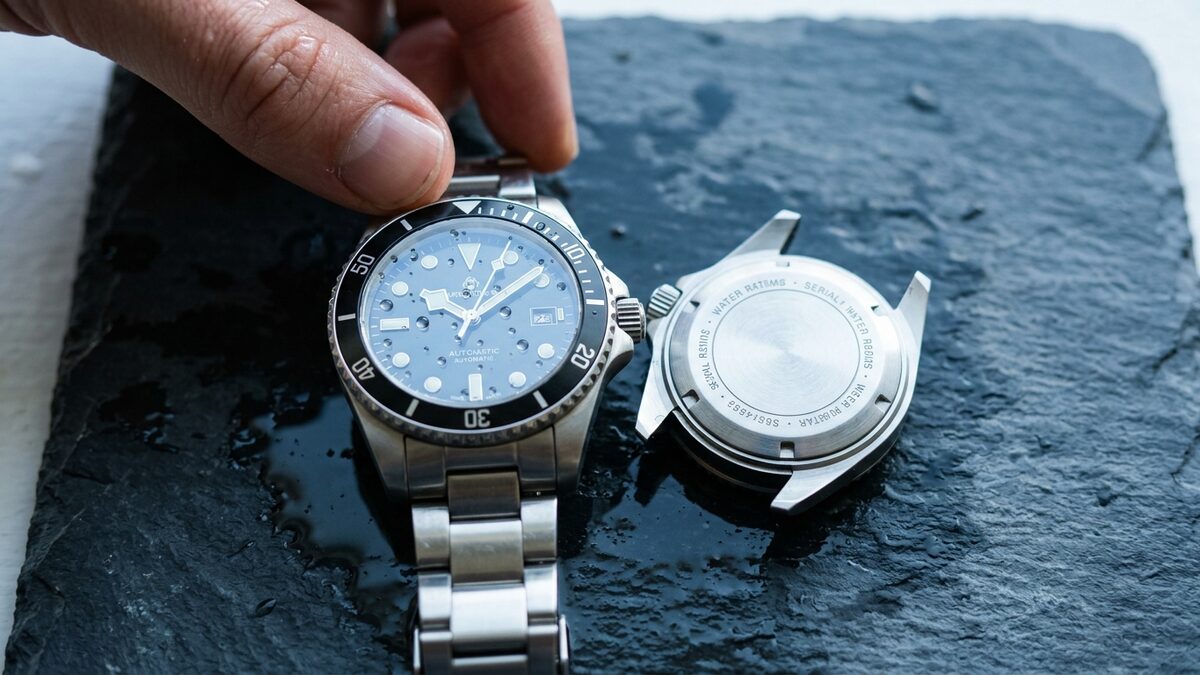
Water resistance is one of the most reassuring-sounding numbers in watchmaking and one of the most misunderstood. A dial marked '30m' sounds like you could happily paddle around in three meters of water. You can't, at least not comfortably. The rating comes from a static pressure test performed in a lab, on a fresh watch, in conditions that have almost nothing to do with a swimmer pushing off a wall. Understanding that gap is the whole game, and it is easier than the marketing makes it look.
First, the units. You will see meters, ATM, and bar used almost interchangeably. One ATM (atmosphere) is roughly one bar, and each unit corresponds to about ten meters of static pressure. So '5 ATM', '5 bar', and '50m' are all describing the same test. The catch is in that word static. The test measures the pressure the case can hold while sitting perfectly still. The moment you move your arm through water, swing it in a dive, or blast it under a faucet, the real pressure spikes well above the number on the dial.
The Numbers on Your Dial: What 30m, 50m, and 200m Actually Allow
Here is the practical translation collectors actually use, working from the most cautious ratings upward.
- 30m / 3 ATM: Splash-proof, essentially. Rain, a quick hand-wash, a spill. Take it off before you do anything more ambitious than that. This is dress-watch territory, and nobody buys a slim dress piece to go snorkeling.
- 50m / 5 ATM: You can wear it in the shower if you must, and a shallow, gentle swim is usually fine. Skip the diving board and the water park slides, where impact pressure gets brutal.
- 100m / 10 ATM: The real everyday sweet spot. Swimming, snorkeling, general water sports. This is the rating I point most first-time buyers toward, because it removes the daily anxiety without demanding a chunky case.
- 200m / 20 ATM and up: Genuine dive territory. Recreational scuba, and honestly more margin than most owners will ever cash in. A watch rated to 200m or 300m is built with a screw-down crown and a thicker case to earn that number.
Notice the jump in real-world capability between 50m and 100m. That single step is where a watch goes from 'be careful near water' to 'stop thinking about it'. If your lifestyle involves pools, lakes, or an ocean more than once a year, 100m is the honest minimum. Anything below that is a fashion-forward choice, not a functional one, and that is completely fine as long as you know it going in.
The other detail people miss is that hot water is the quiet killer. Showers and hot tubs expand the metal case and the gaskets at different rates, and steam molecules are small enough to slip past seals that would stop liquid water cold. A 100m watch that survives a swim can still fog up in a sauna. When in doubt, keep it dry and warm rather than wet and hot.
What to Check Before You Trust Any Water Resistance Rating
A rating on a spec sheet is a starting point, not a guarantee. Whether you are buying new, buying pre-owned, or dusting off something from a drawer, run through this quick checklist before it touches water.
Look for a screw-down crown. On watches rated 100m and above, the crown usually screws into the case to seal it. If it is unscrewed, even a great case is wide open. The single most common water-damage story in this hobby is a crown left out after setting the time. Screw it down, always.
Ask about the gaskets, not just the depth number. Water resistance depends on rubber gaskets that dry out and compress over years. A vintage or pre-owned watch might carry a proud '200m' caseback while its seals are two decades past their prime. The printed number describes the design, not the current condition. If a piece has never been serviced and you plan to swim with it, budget for a pressure test first.
Match the rating to the recipient and the occasion. Buying for someone active, or for a gift that needs to survive a beach honeymoon? Steer toward 100m or 200m with a screw-down crown. Buying a slim gold dress watch for evenings out? A modest 30m rating is period-correct and nothing to apologize for. The best rating is the one that fits how the watch will actually live.
Understand what water resistance does for resale. Dive-capable pieces with intact seals and honest service history tend to hold value well, partly because buyers trust a sports watch that still does its job. A tool watch that has clearly been through the wringer without maintenance is a harder sell. Keeping the seals fresh is not just about safety today, it protects what the piece is worth later.
One last habit worth building: after any real water exposure, rinse the case in fresh water and dry it, especially after saltwater or chlorine. Both are quietly corrosive to gaskets and case metal over time. It takes ten seconds and it is the cheapest maintenance in the hobby.
Read this way, water resistance stops being a source of mild dread and becomes just another spec you can reason about. Learn the units, respect the gap between static and dynamic pressure, screw the crown down, and keep the seals honest. Do that, and the number on your caseback finally means what you always hoped it did.