
Acrylic, Mineral, or Sapphire: A Plain-English Guide to Watch Crystals
Spec sheets love to list the crystal material in three words and move on, as if you already know what it means for the watch on your wrist. You don't have to. The clear cover over the dial is one of the most honest tells about how a watch was built, what it costs to look after, and how it will age. Here is the whole story in plain English.
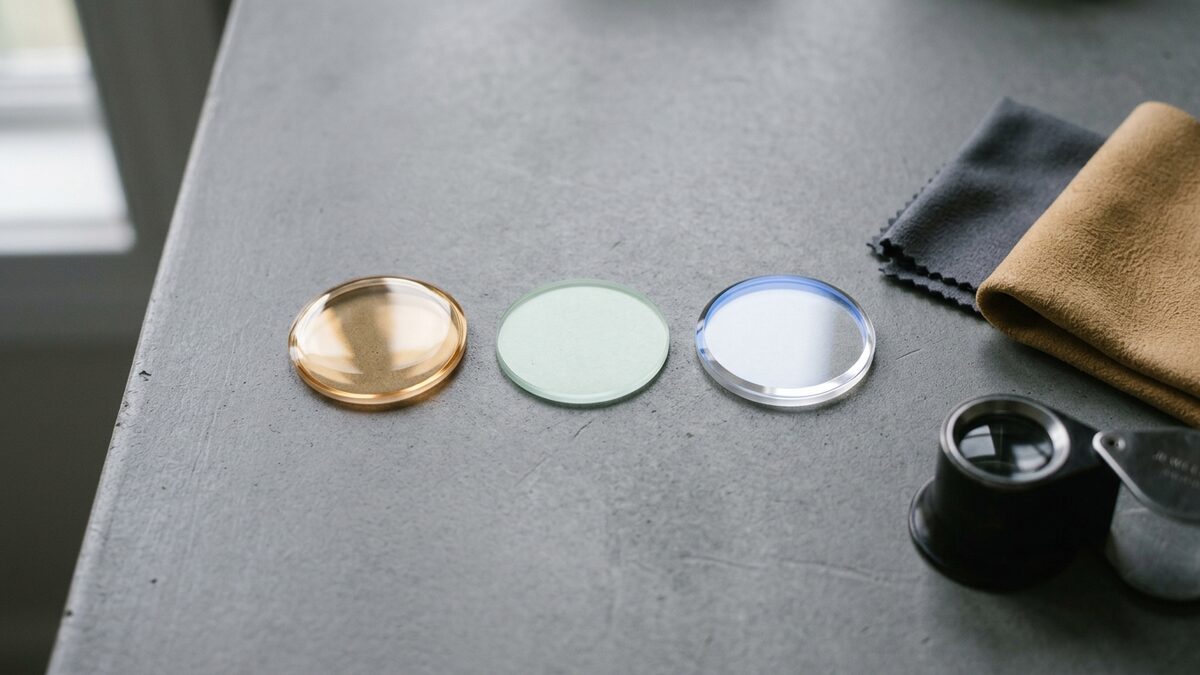
There are really only three materials you will meet often: acrylic, mineral glass, and sapphire. They sit on a rough ladder of hardness and price, but hardness is not the whole picture, and the cheapest option has charms the expensive one cannot fake. Let's take them in order and then talk about how each one actually feels day to day.
Acrylic is plastic, and that word makes people wince before they understand it. It is the softest of the three, so it scratches if you look at it funny. The trade is that it almost never shatters; it takes a knock and shrugs. It also has a warmth to it, a slight glow and a way of bending light at the edges, that collectors of older pieces genuinely chase. Vintage watches wore acrylic because that is what the era offered, and a domed acrylic crystal is a big part of why those watches look the way they do.
Mineral glass is the middle child. It is hardened glass, noticeably tougher to scratch than acrylic but not in the same league as sapphire. It tends to show up on watches built to a price, where the maker wants something better than plastic without the cost of sapphire. The catch is shatter behavior: glass can crack or chip under a sharp impact in a way acrylic won't, so you gain scratch resistance and give up a little of that take-a-hit forgiveness.
Sapphire is the one everyone wants on the spec line, and for good reason. It is synthetic sapphire, grown in a lab, and it is extraordinarily hard, second only to diamond among common materials. In normal life it simply does not scratch. Keys, desk edges, doorframes: it ignores them. The two things it does not love are a direct strike against something harder, which can chip it, and reflections, which is why better sapphire crystals get an anti-reflective coating to keep the dial readable.
How the three crystals behave when life happens
Scratch resistance is where the ladder is steepest. Acrylic picks up hairlines from a week of ordinary wear. Mineral resists casual contact well and only gives in to grit and metal. Sapphire stays clear for years, which is why it has become the default expectation above a certain price.
Shatter behavior runs the other way, and this is the part people forget. Acrylic is the survivor; it crazes or scuffs but rarely fails outright. Sapphire is hard but comparatively brittle, so a sharp point of impact can crack it even though nothing will scratch it. Mineral sits in between and is arguably the least forgiving of a bad day, since it neither flexes like plastic nor resists impact like a well-set sapphire.
Then there is serviceability, the quiet factor that decides how you feel about the watch over decades. A scratched acrylic crystal is a fifteen-minute fix: a little polishing compound and a cloth, and the marks lift right out at home. Mineral can sometimes be polished lightly but usually gets replaced. Sapphire cannot be polished at all; if you somehow chip one, it is a full replacement, and on some watches that is not a cheap afternoon.
Reading the spec sheet like you mean it
Once you know the three, a spec line stops being jargon and starts being a forecast. "Hardened mineral crystal" on an affordable diver tells you the maker spent where it counted and expects you to be a little careful. "Sapphire with anti-reflective coating" tells you the dial will stay crisp and clear for the life of the watch, and that you are paying for that peace of mind. "Acrylic" or the older word "hesalite" on a tool watch or a reissue is not a cost-cut; it is often a deliberate nod to heritage, and it means you get the warm look and the easy at-home polish in exchange for babying it a bit.
So which should you want? It honestly depends on the wrist it lives on. If you knock around job sites or travel hard, the forgiveness of acrylic or a well-protected sapphire matters more than a perfect surface. If you want a watch you never have to think about, sapphire earns its reputation. And if you are drawn to vintage character, a domed acrylic crystal gives a watch a soul that flat sapphire, for all its clarity, simply reads as glass.
The good news is there is no wrong answer here, only trade-offs you now understand. The crystal is the one part of a watch you look through every single time you check the hour, and knowing what you are looking through makes the whole object a little more rewarding. Next time a listing says sapphire, you will know it means clear-for-life; when it says acrylic, you will know it means warmth, history, and a polishing cloth in the drawer.