
What Makes a Watch Dial Tropical, and Why Collectors Pay More for It
A tropical dial is one of the few things in vintage watch collecting where damage adds value. The black lacquer that left the factory in 1965 is now a warm chocolate brown, and the same reference with an unfaded dial sells for a fraction of the price. The shift looks like a happy accident, and in a sense it is, but the chemistry is consistent enough that experienced collectors can spot the difference between a genuine aged dial and a forced one within seconds.
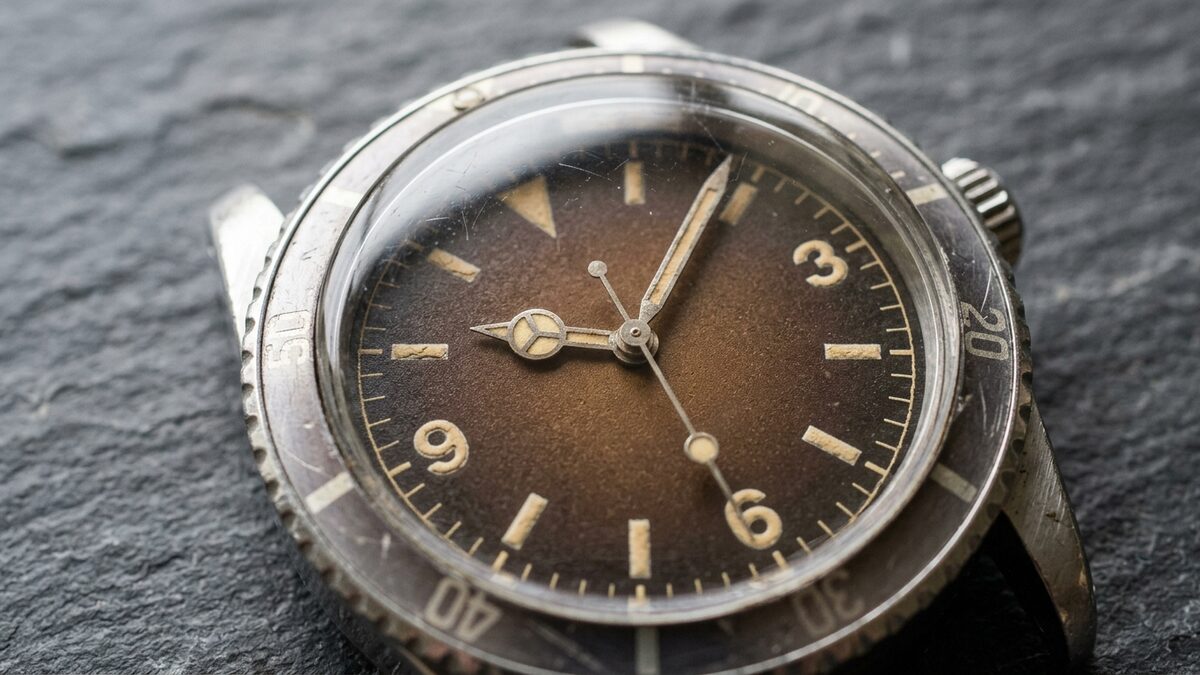
The term tropical gets thrown around loosely, so it helps to define it narrowly. A tropical dial is a black or dark-colored dial that has shifted to brown through prolonged exposure to ultraviolet light, heat, and humidity. The shift is uneven, usually warmer toward the center where the crystal magnifies sunlight, and the surface texture stays intact. A dial that is brown because the lacquer cracked, flaked, or was refinished is not tropical. It is damaged or restored, which are different conversations entirely.
The chemistry comes down to the pigments and binders used in mid-century dial production. Black dials from the 1950s and 1960s typically used carbon-based pigments suspended in a nitrocellulose or shellac binder. Carbon itself is stable, but the binders are not. UV exposure breaks down the polymer chains, the binder yellows, and the yellow casts over the black pigment to produce brown. The exact shade depends on which binder was used, how thick the layer was applied, and how much UV the watch actually saw over sixty years on a wrist or in a drawer.
This is why two examples of the same reference can age completely differently. A Submariner that lived in Florida from 1962 to 1985 looks nothing like one that sat in a Swiss bank vault for the same period. The vault watch is still glossy black. The Florida watch has a warm caramel dial, faded indices, and probably a creamy patina on the lume plots. Neither is more correct than the other. They are different artifacts of how the watches were used.
Why collectors pay a premium for the brown shift
The premium exists for a mix of aesthetic and scarcity reasons. Aesthetically, a tropical dial reads warmer on the wrist, pairs better with aged lume, and signals that the watch has a life history rather than being a safe-queen. Scarcity-wise, tropical examples are uncommon because most dials either stayed black, were swapped during service, or were refinished by jewelers who thought they were doing the owner a favor. A factory dial that survived sixty years and aged evenly is genuinely rare for popular sports references.
Prices reflect this. A vintage Submariner reference 5513 with a clean black dial might trade in one range, while the same reference with a uniform tropical shift and matching patina across the lume can sell for two to three times more depending on the depth and evenness of the brown. The market also distinguishes between light tropical (warm chocolate, mostly even), full tropical (deep brown, sometimes called root beer), and what dealers call ghost dials, which are extreme cases where the dial has faded to a near-gray sand color. Each tier has its own pricing logic.
The same effect applies beyond Rolex sports references. Early Speedmasters, Heuer chronographs, military-issued field watches, and Tudor dive watches all show the tropical effect when conditions align. The dials are valued for the same reasons: the patina is genuine, uneven, and unrepeatable. Collectors are buying the documented evidence of six decades of light exposure, which cannot be faked convincingly at scale.
How to tell genuine patina from artificial aging
The fakes have gotten better in the last ten years, which is why this matters. Cooked dials are produced by baking originals in a low oven, exposing them to concentrated UV lamps for weeks, or chemically treating the surface with peroxide and mild solvents. The result can look convincing in photographs but usually falls apart in person.
The first tell is evenness. A genuinely tropical dial is rarely uniformly brown. There are subtle gradients where the case, crystal bezel, or hands shielded parts of the surface from light. The area around the date window often stays slightly darker because the cyclops magnified UV onto a smaller patch and the surrounding metal absorbed some of the heat. Forced examples tend to brown evenly across the whole surface, which never happens in nature.
The second tell is the relationship between the dial and the lume. On a genuine tropical example, the lume plots and the dial aged together over the same decades, so the cream tone of the lume harmonizes with the brown of the dial. On a cooked dial paired with relumed hands or fresh lume plots, the colors fight each other. The dial looks aged, the lume looks new, and the mismatch is visible at arm's length once you train your eye for it.
The third tell is documented history. A watch that comes with original purchase papers from 1968, a service history showing the dial was never swapped, and family provenance tracing the wear pattern is much more credible than a loose tropical dial offered with no chain of custody. Premium pricing on tropical examples almost always tracks with the strength of the paperwork, and serious collectors will walk away from a brown dial with no story before they pay a premium for it.
The last layer is the dealer reputation and the willingness to allow a third-party inspection. A specialist who handles vintage sports watches regularly can usually identify a cooked dial under a loupe within a minute by examining the binder texture, the way the brown sits relative to the printing, and how the surface reflects raking light. Anyone selling a high-tier tropical example should welcome that inspection. If they push back, the price premium is not worth the risk.