
Buying a Vintage Rolex Submariner: What Seasoned Collectors Actually…
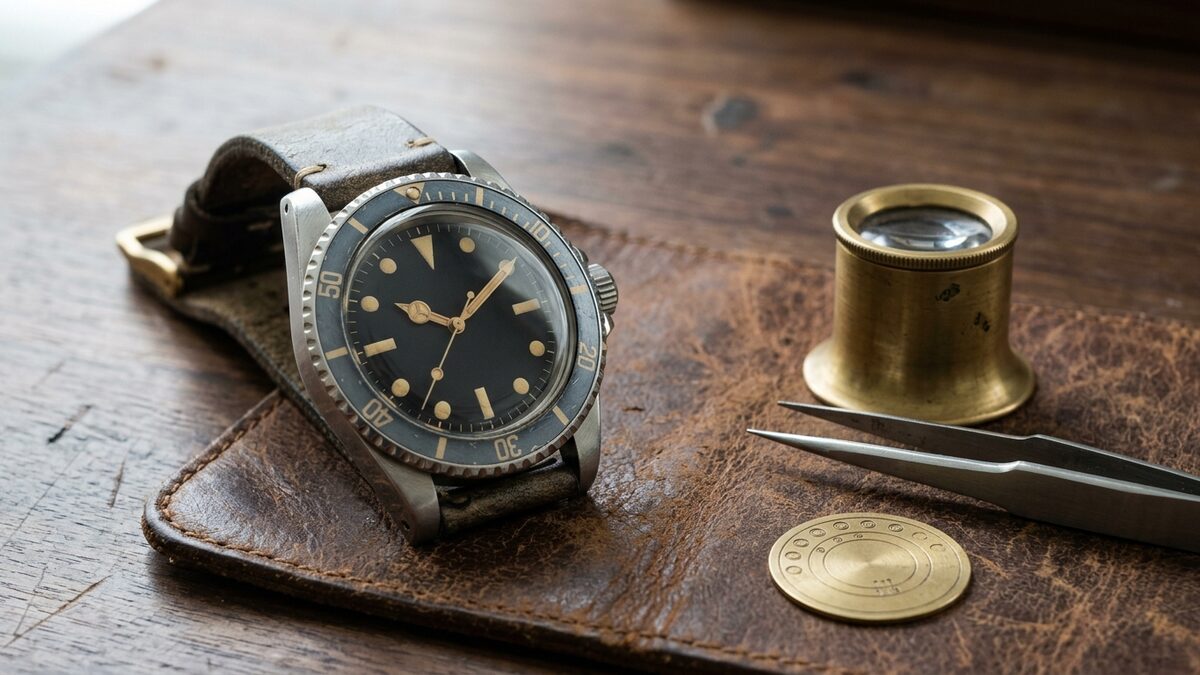
The first vintage Submariner you handle in person will feel smaller than you expect. That moment, when the case sits on your wrist and the lugs do not extend the way modern marketing photos suggest, is when most enthusiasts realize the basics they read online were never going to be enough. The watch you bring home depends on what you can verify in the next ten minutes.
Start with the case. A genuine vintage Submariner case has proportions that catalogs cannot fake. The lugs should taper smoothly, with a subtle bevel running along the top edge that catches light when you tilt the watch. Over the decades, polishing has rounded countless cases past recognition. A sharp lug edge is one of the strongest signals that a watch has been left alone. Run a thumbnail along the bevel. If it disappears into a soft curve, the case has been worked over, and that is reflected in value whether the seller volunteers it or not.
The crown guards on references from the 1960s onward should sit symmetrical and proud. Asymmetric guards usually mean a refinish gone wrong. The crown itself should screw down with positive resistance, never sloppy, never grinding. If the crown wobbles before threading catches, the tube has worn, and a service is in your near future.
The dial is where stories get told
Dial inspection is the layer most new buyers underestimate. Authentic vintage printing has microscopic depth. Look at the lettering under a loupe and you should see slight relief, with edges that are crisp rather than feathered. Reprinted dials lay flat. The coronet at twelve has changed shape across decades, and matching the coronet to the reference and production year is one of the first checks a seasoned collector runs.
Tritium plots age in characteristic ways. Genuine tritium aging produces a creamy to mustard tone, often uneven across the dial, with the plots at the cardinal points sometimes drifting darker than the rest. Perfectly uniform aging is suspicious. Service dials and relumes are common, and a relume is not automatically a deal breaker, but it must be disclosed and reflected in the price. The hands should share the tone of the dial plots. A dial gone mustard with stark white hands is a mismatch that points to replacement hands or a service swap.
Bezel inserts deserve their own moment. The faded blue-to-grey ghost insert that collectors prize comes from years of UV exposure and is essentially impossible to fake convincingly. A genuinely faded insert shows gradient rather than uniform color shift, and the pearl at twelve should match the era of the watch. Replacement inserts are cheap and ubiquitous, so this is where a knowledgeable seller is worth their margin.
Casebacks, movements, and the parts you cannot see
The caseback is your second history book. Reference and serial numbers sit between the lugs on watches from this period, not on the caseback itself, but engravings on the inside of the caseback tell their own story. Service marks accumulate as tiny scratched dates or initials. Several service marks suggest a watch that has been cared for. None at all on a sixty-year-old watch is worth questioning.
Movement consistency is the deepest layer of authentication and the one most often skipped. The movement caliber should match the reference and production year. Movement stamps, including the engraving on the bridge and the serial on the rotor mount where applicable, should read cleanly. A movement that does not match its case is a Frankenwatch, and these turn up at every price tier, including the upper one. Asking to see the movement before purchase is reasonable. A seller who refuses is telling you something.
Listen to the watch wind. The crown should turn smoothly with a soft purr from the rotor, not a gritty rattle. A vintage automatic that has been recently serviced will run within reasonable accuracy, and a seller who has invested in service will usually mention it. If the watch has not been serviced in fifteen years, budget for it. Service intervals on vintage calibers are not optional, and a delayed service often means a movement that needs more than fresh oil.
The trap most enthusiasts fall into is wanting the watch too much. The piece in front of you will not be the last vintage Submariner you encounter. Walk away from anything that does not check out, and walk toward sellers who let you inspect with a loupe, ask questions, and bring an outside opinion. The collector community is small, and a good vintage piece has usually passed through hands that talk. Reputation travels with the watch, and reputation is half of what you are buying.
The other half is the watch itself: a case that has aged honestly, a dial that tells one coherent story, a movement that matches its body, and an insert the color of a Tuesday afternoon in 1968. When you find it, you will know.