
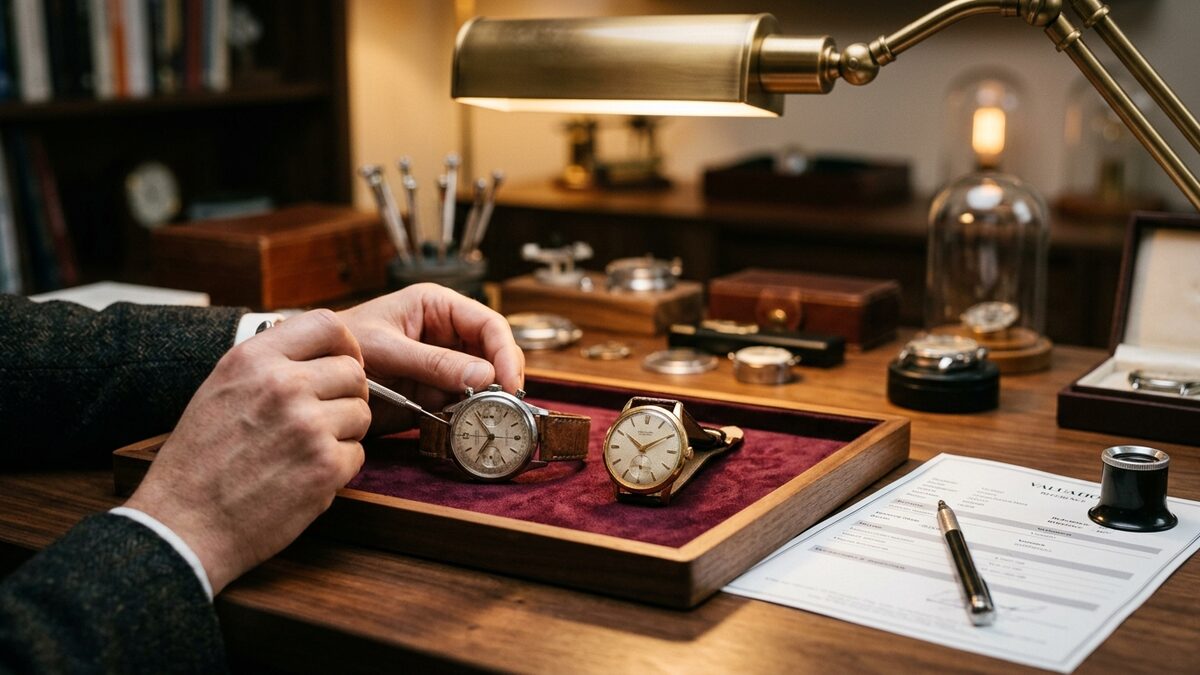
The watch on your wrist is probably worth more than your insurance thinks it is. If you bought it three or more years ago, or if your appraiser used a printed price guide rather than live market data, your coverage almost certainly lags behind what it would actually cost to replace the piece.
The problem with most jewelry appraisers
Insurance jewelry appraisers are, in general, trained to evaluate diamonds and traditional fine jewelry. Watches are a specialized sub-category that most appraisers do not follow closely. They use industry price guides — updated annually if the publisher is diligent, every few years if not — and apply a markup factor to produce a replacement value.
This method works adequately for a diamond solitaire in a simple setting, where prices shift slowly and predictably. It works badly for luxury watches, where the pre-owned market has developed into a parallel pricing system that diverges significantly from manufacturer retail, often in both directions, and moves faster than any annual price guide can track.
The result is appraisals that are either grossly understated (for watches that have appreciated) or overstated (for watches that have softened). Both are bad. An understated appraisal means you receive less than the actual replacement cost after a claim. An overstated appraisal means you are paying premiums on coverage you cannot actually collect.
How the secondary market broke the old model
Before roughly 2015, the pre-owned luxury watch market was fragmented across dealers, auction houses, and private transactions, with no unified public pricing. Retail was the only transparent reference point, so appraisers used it. The markup to retail replacement value was defensible.
The last decade changed this structurally. online marketplaces aggregated real-time asking prices from thousands of dealers globally. eBay's sold-listings data made closing prices — not asking prices, actual transaction prices — publicly accessible. The grey-market dealer network grew sophisticated enough that certain references traded consistently above retail, sometimes substantially above.
For a Rolex Submariner 124060, replacement cost today is not the manufacturer's discontinued retail price — it is the current secondary market price for a clean example in comparable condition. These two numbers are not the same. For many references they differ by 30 to 60 percent. For trophy references like the Daytona 116500LN or the Nautilus 5711, they have at times differed by a factor of three or four.
An appraiser who is not pulling live secondary market data is producing a document that does not reflect reality.
The five things a current-data appraisal must contain
- The full reference number. Not "Rolex Submariner" but "Rolex Submariner 124060, stainless steel, black dial, black ceramic bezel, Oyster bracelet." The reference is the pricing unit. Everything else is description.
- The condition grade. A mint-condition example in full set replaces at a different price than a lightly worn example with no papers. The appraisal must specify condition and documentation status.
- The data source and date. The appraisal should state which market platforms were consulted, the date of the query, and which quartile of the data was used (replacement cost should use the upper quartile — the cost to replace promptly, not the lowest available price).
- The replacement methodology. Is the stated value the cost to buy an equivalent from a reputable dealer within 30 days? That is the correct standard. It should be stated explicitly.
- A re-appraisal cadence recommendation. For high-demand references, every 24 months. For stable references, every 36 months. This should be part of the appraisal document.
How to check your current appraisal
Pull out your insurance appraisal. Find the reference number — it should be listed specifically. If it says "Rolex Datejust" without a six-digit reference number, the appraisal is structurally insufficient. If the date on the appraisal is more than two years ago, assume it is out of date without checking further.
If the reference number is present, look up closed sales for that reference on the open market (filter to sold transactions, last 90 days, condition comparable to yours). Compare the upper-quartile price in the data to your appraised replacement value. If they are more than 20 percent apart — in either direction — your coverage needs attention.
What to do about it
Request a current-data re-appraisal from a specialist. The appraiser should be able to explain their methodology without prompting. If they reference a printed price guide as their primary source, find a different appraiser.
Once you have a current appraisal, bring it to your insurance broker. Specialty watch insurance riders and collectors' policies (distinct from standard homeowner's scheduling) typically offer agreed-value coverage — meaning the insurer pays the appraised amount in full, without depreciation argument. That structure requires a defensible current appraisal.
Lastly: photograph your watches on a dated receipt, write down the serial number, and store that documentation separately from the watch. In a theft or loss claim, the serial number is how the watch is identified in stolen-watch registries — and it is the first thing a claims adjuster will ask for.
The question to ask yourself is simple: if your watch disappeared tomorrow, would your insurance pay what it would actually cost to replace it? If you are not certain the answer is yes, the appraisal is the first thing to check.
Using a watch as collateral for a loan rather than insuring it? The appraisal requirements differ significantly — lenders need fair market value, not replacement cost. See our guide to luxury watch appraisal for a bank loan for what lenders actually require.