Values & guides
A working breakdown of the Offshore's references, sizes, materials, and the era markers that separate one generation from the next.
The Royal Oak Offshore arrived in 1993 as reference 25721ST, a 42mm steel chronograph that pushed Gerald Genta's original octagon into bolder territory. Collectors quickly nicknamed it "The Beast." Over three decades the line has grown into dozens of references spanning chronographs, divers, tourbillons, and ladies' models, in steel, titanium, ceramic, and precious metals. Most buyers shopping the secondary market focus on the self-winding chronograph, which remains the core of the family and the reference type you will see most often in stock.
AP reference numbers carry real information once you learn the pattern. Take 25940SK.OO.D002CA.01.A. The first block, 25940, identifies the model and generation. The letters that follow, SK here, indicate the case and bezel material treatment. OO is a separator. The next block, D002CA, encodes the dial and strap combination. The final digits track variant and strap iterations. Material codes worth memorizing: ST and SK denote steel, OK and OR denote pink gold, IO and TI denote titanium, and ZZ appears on several steel-and-ceramic ladies' configurations such as 26076SK.ZZ.D010CA. Decoding the string tells you metal and configuration before you ever see the watch.
The first generation, roughly 1993 to 2003, centers on the 25721 in steel and gold. These early Beasts use the Méga Tapisserie dial, a tachymeter-free chronograph layout, and the caliber 2126/2840 built on a Jaeger-LeCoultre base with a Dubois Dépraz module.
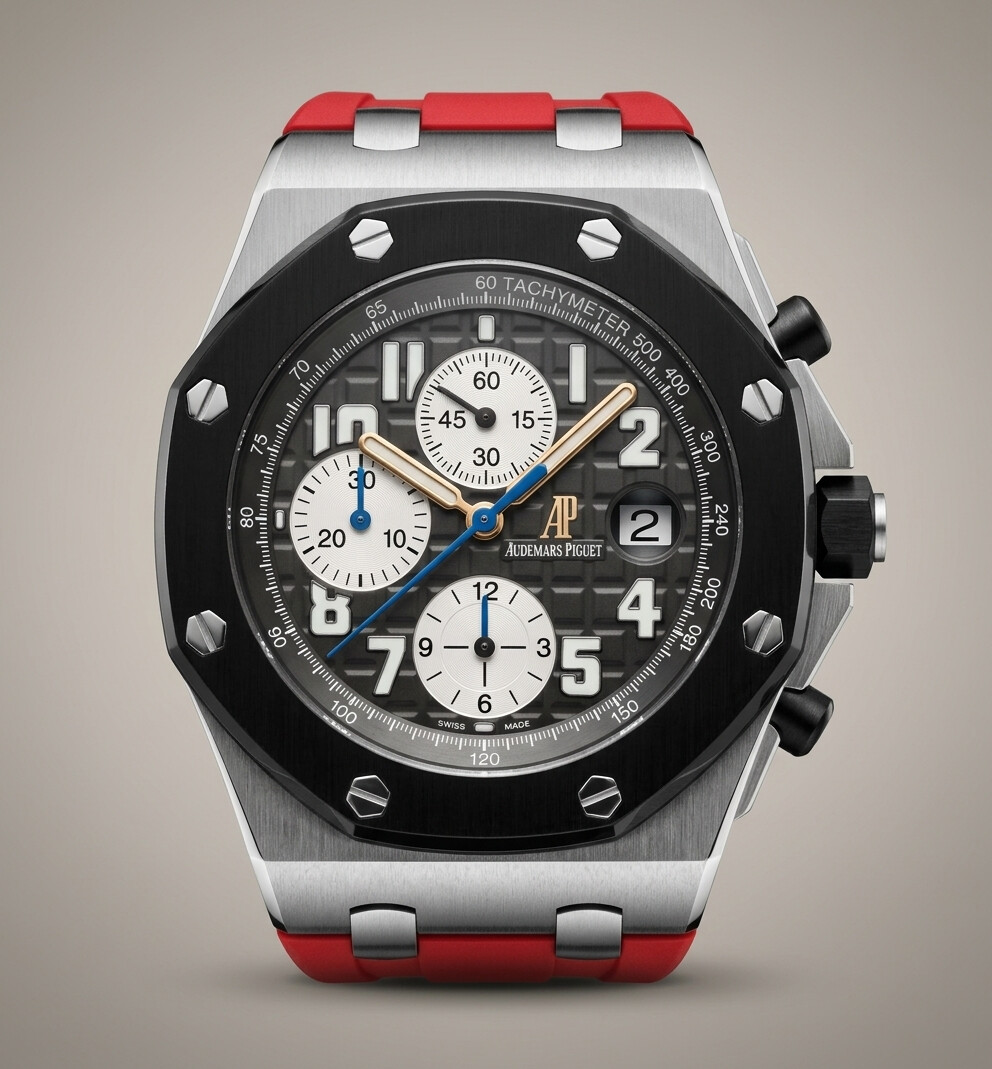
The mid-2000s brought the 25940 chronograph, the reference you see across much of the current market. It introduced the now-familiar rubber-clad pushers and ceramic accents and ran the caliber 2326/2840. This era also produced the heavily themed and limited editions, including titanium pieces like the 26078IO, which carries a 44mm case and integrated rubber strap. Expect 2004 to 2011 production dates on these.
From 2014 onward, AP overhauled the line with the 26470 (42mm) and 26400 (44mm) chronographs, redrawn pushers, an interchangeable strap system on later runs, and eventually the in-house caliber 4401 chronograph movement from 2019. Knowing which era a watch belongs to sets the correct expectation for movement, finishing, and price.
The Offshore was conceived large. The classic chronograph measures 42mm, the dimension that defines references like the 25940 and 26470. Heavier flagship chronographs and many titanium editions, including the 26078 and 26400, run 44mm and wear substantially due to thick bezels and pronounced lugs. Ladies' and mid-size models drop to 37mm, as seen on the 26076 with its white dial and ceramic bezel. You will occasionally see 40mm listings used loosely; verify against the reference, since the 25940 is correctly a 42mm watch. Case thickness on the chronographs typically sits between 14mm and 15mm, so these are not slim dress pieces under a cuff.
The Méga Tapisserie dial, with its oversized waffle guilloché, is the Offshore signature and distinguishes it from the finer Petite Tapisserie of the standard Royal Oak. Within the 25940 family you will find black standard dials, black Tapisserie versions with applied Arabic numerals, and gray dials on the rose gold 25940OK. Bezels appear in three principal forms: brushed and polished steel or titanium, and black ceramic, the last giving the case a darker, more uniform look. Straps move between vulcanized rubber, the most common pairing, and leather on precious-metal references such as the rose gold 25940OK on leather. Steel remains the volume material, titanium appeals to buyers who want the size without the weight, and rose gold sits at the top of the range.
Start with the case back. AP engraves the full reference and an individual case number; cross-check both against the dial configuration and the strap. Confirm the Tapisserie pattern is crisp and deep, with no softness in the squares. Inspect the pushers and crown, which on Offshores are guarded and screw-down on most chronographs. The strap-to-case integration should be tight and even; aftermarket straps and incorrect deployant clasps are common substitutions that affect value. Movement and box-and-papers presence matter most on themed and limited editions. When the metal code in the reference disagrees with what your eyes tell you, stop and verify.
Our present inventory of seven Offshores runs from roughly $21,150 to $44,100, which mirrors the model's broad spread. Steel 25940 chronographs and the 37mm ceramic-bezel pieces anchor the lower band, mid-2000s titanium references sit in the middle, and rose gold examples reach the top. Pricing tracks metal, size, condition, and whether the configuration is a standard production run or a limited edition. Buy the reference and era you actually want, then let condition and completeness guide the final number.
Current availability and dealer-direct pricing are at My Watch Dealer.
See current inventory & pricing at My Watch Dealer →