Values & guides
A dealer's breakdown of the Explorer II lineage, from the 1655 to the 226570, with the details that matter at purchase.
The Explorer II has always been the practical outlier in Rolex's professional range. Built around a fixed 24-hour bezel and an independent GMT-style hand, it was made for cavers and researchers who lose track of day and night. Five distinct references define its history. Knowing how they differ protects you at the point of sale.
The original. A 39mm steel case, a straight 24-hour hand painted orange, and a fixed engraved steel bezel. Early dials read "Explorer II" in a specific font, and collectors track the "Mark" variations (Mark 1 through Mark 5) by the shape of the 24-hour numerals and the coronet. The 1655 ran the caliber 1575 with no quickset date. It earned the "Steve McQueen" nickname despite McQueen never wearing one. Prime, honest examples now trade well into five figures, so provenance and dial originality carry real weight here.
A short transitional run, and the first to grow to 40mm with the caliber 3085. This was the debut of the now-familiar layout: a movable 24-hour hand that could be set independently to track a second time zone, plus the crown-guard case and sapphire crystal. The 16550 came in black or white ("polar") dials. Early white dials are known to have aged to a cream or ivory tone, which today commands a premium. Because production was brief, the 16550 is scarcer than its successor and appeals to buyers who want a bridge between vintage and modern.
The workhorse, and the reference most buyers start with. It kept the 40mm case and offered black or white dials on an Oyster bracelet. The long production life means several updates. Early examples used the caliber 3185; from roughly 2007 Rolex fitted the caliber 3186 with the Parachrom hairspring. Tritium lume gave way to Luminova and then Super-LumiNova, so a serial number and dial code help date any given watch. We currently stock a 1999 16570 with a black dial and standard steel bezel, plus a 2003 example wearing an aftermarket 24-hour PVD bezel, a reminder to confirm bezel originality before you commit. The 16570 remains the sweet spot for value: robust, serviceable, and available across a wide price band.
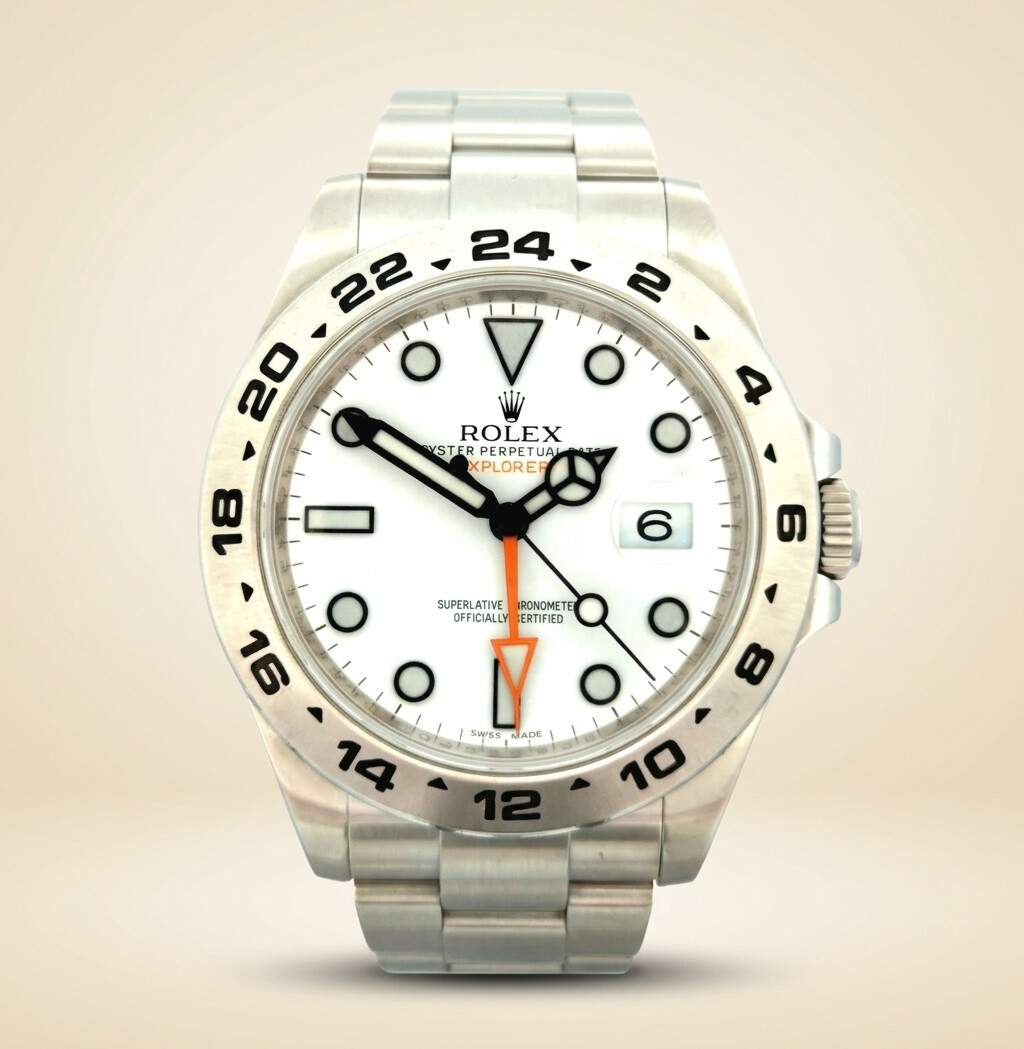
The 50th-anniversary redesign. The case jumped to 42mm with a Maxi case and broader lugs, and Rolex reintroduced the orange 24-hour hand as a nod to the 1655. Inside sits the caliber 3187 with Parachrom hairspring and Paraflex shock protection. The bracelet gained the Easylink 5mm comfort extension and a solid Oysterlock clasp. Both black and white dials continued, with the white version using black-outlined hour markers for legibility. Our 2012 216570 with a white dial and Oyster bracelet is a representative example of this generation. On the wrist the 42mm case wears large, so try before you buy if you have a slimmer wrist.
The current model. It keeps the 42mm footprint but slims the lugs and case sides for a more refined profile. The upgrade inside is the caliber 3285, the same movement family used in the GMT-Master II, offering roughly 70 hours of power reserve and Chronergy escapement. The bracelet clasp and Easylink carry over in improved form. Dials remain black or polar white with the orange hand. This is the reference to consider if you want full warranty coverage and the latest engineering.
Start with case size: 39mm points to a 1655, 40mm to the 16550 or 16570, and 42mm to the 216570 or 226570. The 24-hour hand is a fast tell. A straight orange hand means 1655 or the two newest references; a plain hand matching the hour hand indicates the 16550 or 16570. Check the movement caliber against the serial-based production year, and verify the bezel is factory Rolex, since replaced or coated bezels appear regularly on the secondary market. Lume type (tritium, Luminova, Super-LumiNova) further narrows the year.
Every Explorer II shipped on a steel Oyster bracelet. The standard lug width is 20mm, which is why a loose 20mm Oyster bracelet is a useful spare or replacement for a 16570. Aftermarket rubber straps, such as the Arctic-white-with-mandarin and jet-black options we carry, let owners dress the watch down without altering the original bracelet. Keep the factory bracelet with the watch; it protects resale value.
Our current Explorer II inventory spans five pieces from roughly $2,250 to $10,950, covering vintage-adjacent 16570 examples through the larger 216570. Pricing tracks condition, dial color, box and papers, and service history. Polar white dials generally command a modest premium over black. Buy the best condition your budget allows, confirm the reference details above, and the Explorer II rewards you as one of the most wearable tool watches Rolex builds.
Current availability and dealer-direct pricing are at My Watch Dealer.
See current inventory & pricing at My Watch Dealer →