Values & guides
Most dive watch buyers never see open water, here is what the tool features actually do for people who wear them on dry land every day.
The unidirectional rotating bezel on a dive watch exists for a specific reason: it marks elapsed time underwater, and it turns only counterclockwise so an accidental knock always shows less time remaining, never more. That safety logic is built into the design at a mechanical level. On land, that same bezel is a general-purpose timer you can set with your thumb, parking meter, stovetop, a meeting you need to leave in 40 minutes. Most people who own dive watches use the bezel this way far more often than they ever use it near water, and that is a perfectly reasonable way to use it.
ISO standards for dive watches require a minimum of 100 meters of water resistance, and purpose-built divers typically rate to 200 or 300 meters. That kind of rating is overkill for anyone who is not actually diving, but the practical benefit on dry land is real. Rain, a car wash, a pool, the shower, none of it registers. You wear the watch and stop thinking about water entirely. For anyone who has ever killed a watch by wearing it somewhere wet and forgetting about the limitations, that low-grade peace of mind compounds over years of daily use.
Dive watches are generally built with thicker sapphire crystals and heavier case construction than dress watches of a similar size, because they have to handle pressure. On land, that same construction means a watch that absorbs accidental contact with door frames, gym equipment, and desk edges without showing it. Sapphire is hard enough that everyday abrasion, the kind that hazes a mineral crystal within months, mostly does not register. The trade-off is size and weight, which is a legitimate consideration if you prefer something slimmer on the wrist. But for buyers who want a daily-wear watch that is genuinely durable, the tool construction delivers that without any extra effort.
High-contrast dials, large applied indices, and broad luminous hands are standard on dive watches because divers need to read time and depth quickly in low visibility. On land, that legibility is just convenient. The time is readable at a glance from an odd angle, in a dark room, or without tilting the watch toward a light. It sounds like a minor point until you spend a month wearing a watch with a light dial and thin hands and then switch back. The difference is noticeable and immediate.
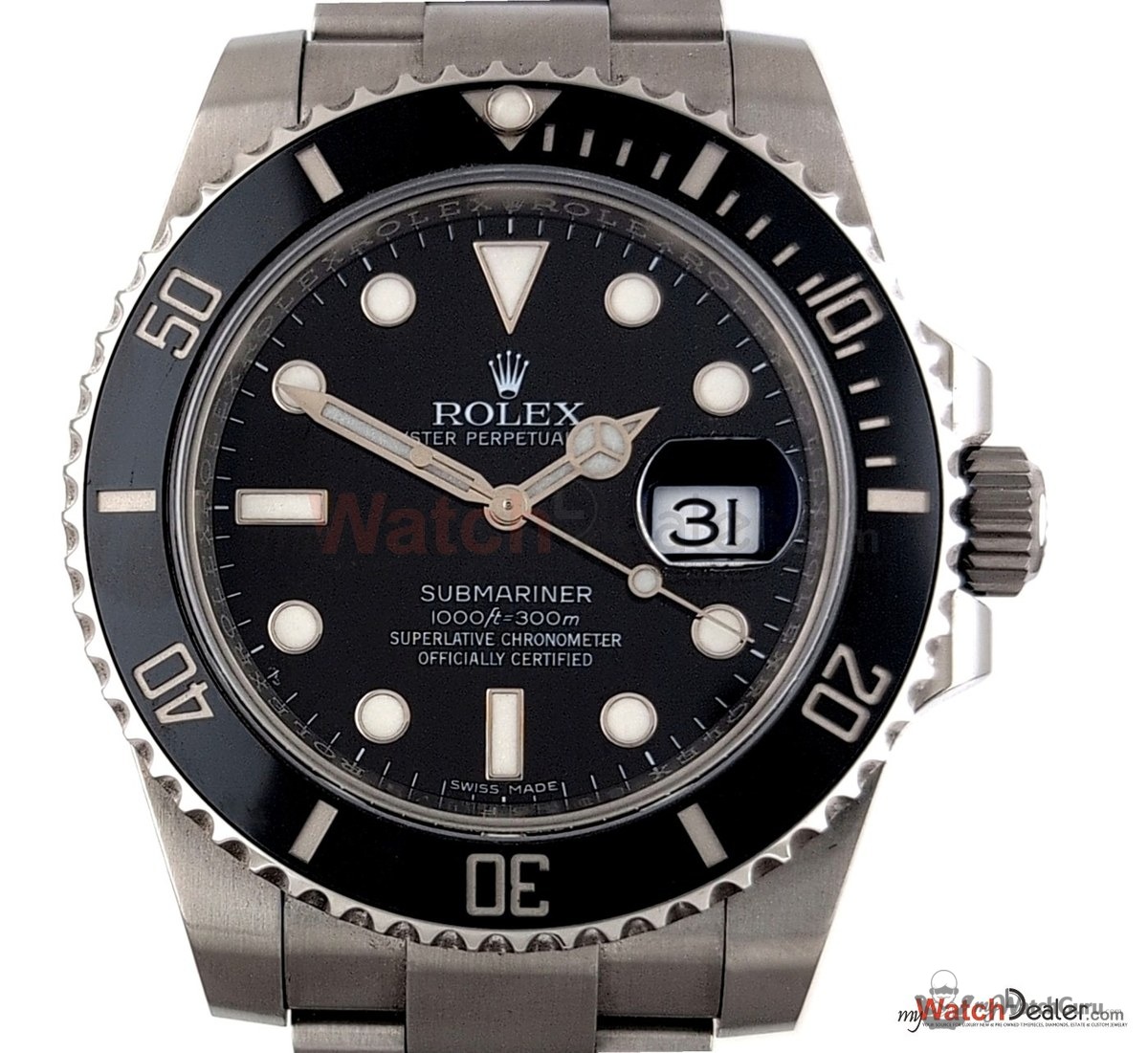
The Rolex Submariner 116610LN is a 40mm steel Submariner Date with a black dial and black ceramic bezel, from 2017, in used condition with papers. The ceramic bezel insert on this generation resists fading and surface scratches far better than the aluminum inserts on earlier references, which is worth paying attention to for a watch that sees daily wear. The Oyster bracelet is a well-engineered piece on its own, solid end links, a clasp that holds its adjustment, and a profile that sits close enough to the wrist to avoid catching on cuffs. Coming with papers but no box means the ownership documentation is intact, which matters when the watch eventually changes hands. For a buyer who wants a legible, water-resistant, genuinely durable daily wearer at 40mm, this is the reference most people picture when they decide they want a Submariner.
A rated dive watch is a practical choice for someone who wants a single watch that handles most situations without demanding much thought. The tool origins translate directly to durability, legibility, and water resistance that dress watches and thinner sport watches often trade away. Whether you ever put a tank on your back is beside the point. The engineering decisions that make a watch function under pressure also make it function on a wrist, in daily life, for a long time.
Sold through My Watch Dealer, our retail desk — full details, current price and purchase all happen there.
View this piece at My Watch Dealer ›