Values & guides
What the reference is, what dial and metal variations to expect, and why most examples arrive without a bracelet.
Rolex's Datejust ref. 1601 is a 36mm Oyster case watch with a fluted bezel and a non-quick-set date mechanism. Rolex produced it over a long run stretching from the early 1960s into the late 1970s, which is a large part of why surviving examples are so plentiful today. That production span also explains the wide variety of dials, metals, and bezel configurations a buyer will encounter when searching the secondary market.
Within the broader 160x Datejust family, the key distinction for the 1601 is the fluted bezel. Other references from the same era used smooth bezels, and the fluted version gave the 1601 a slightly more formal character. Cases came in all-steel or two-tone steel and yellow gold, with precious metal variants available as well. Steel is by far the most common configuration found on the secondary market.
Because the 1601 was built over such a long production window, dial options varied considerably. Silver dials with applied index markers and black dials with index markers are among the more frequently encountered versions. Stick or baton dials and early gilt dials also turn up in the market. The fluted bezel came in both yellow gold and white gold even on otherwise all-steel cases, and both were factory configurations, not aftermarket modifications.
Condition varies widely. Cases from early 1960s production tend to show more wear simply due to age, while later examples can sometimes be found in better shape. The non-quick-set movement means adjusting the date requires pulling the crown to the first position and advancing it manually, which is worth keeping in mind if you wear the watch regularly across different time zones or let it run down.
Most 1601s on the secondary market come as head-only, meaning the case and movement with no bracelet attached. Original Oyster or Jubilee bracelets for the 1601 era have been separated from their watches over decades, lost, swapped out for aftermarket pieces, or handed down on their own. Finding a 1601 with a correct period bracelet intact is uncommon enough that buyers should plan around it rather than expect it.
Practically, this means accounting for bracelet costs separately. A period-correct original or a well-matched aftermarket piece is an additional purchase, not something bundled with the watch head. Do not treat the absence of a bracelet as a red flag specific to any individual example. It is simply the norm for this reference, and many buyers put the 1601 head on a leather strap or a good aftermarket Jubilee-style piece and find it entirely wearable.
Box and papers are similarly rare across this reference. When papers do surface, they add documentation value, but the watch's mechanical integrity matters considerably more for daily ownership.
Three current examples at My Watch Dealer show the range a buyer will encounter shopping this reference.
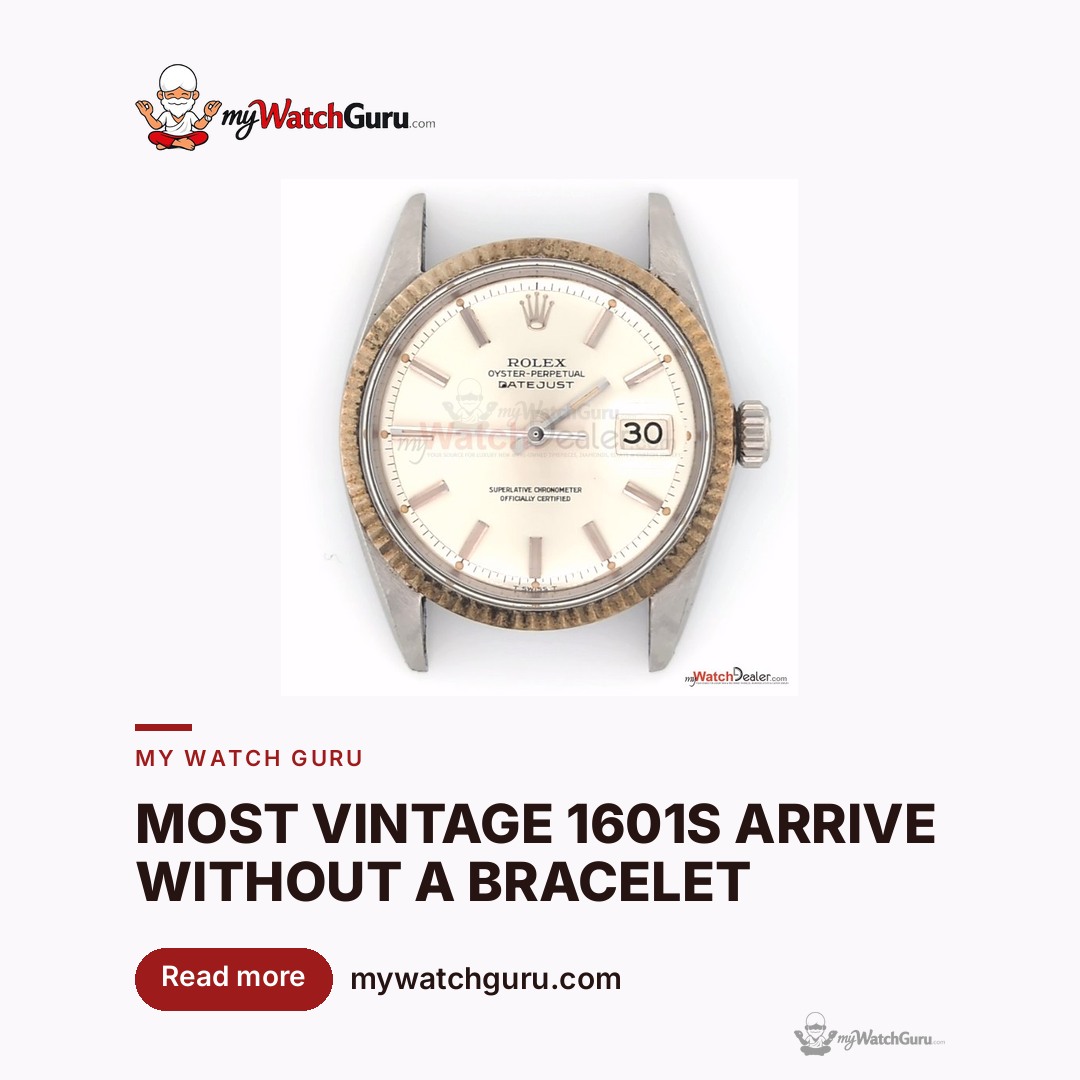
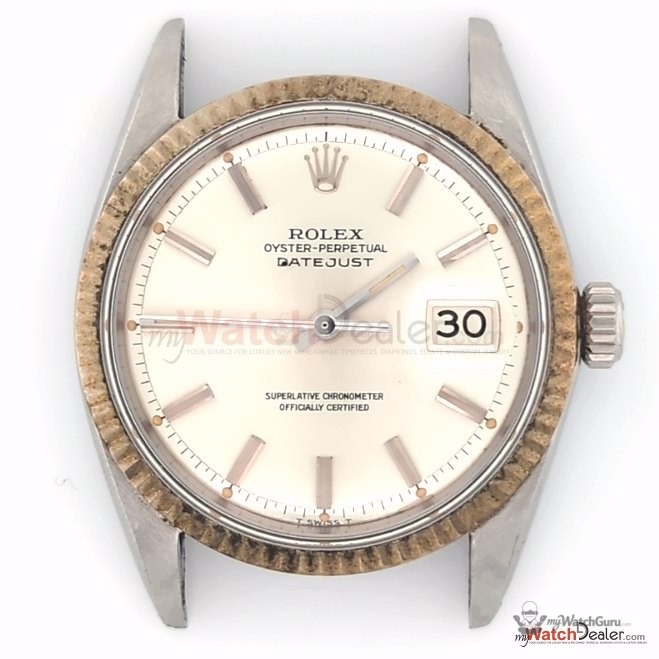
The Rolex Datejust 1601 in steel with a silver index dial and yellow gold fluted bezel dates to 1962, placing it in early production. It comes with papers but no box and is listed as head only, which is exactly what the market for this reference typically looks like. A silver index dial on an early 1601 is a clean, unfussy configuration, and the yellow gold fluted bezel against the steel case is a factory pairing, not a later modification.
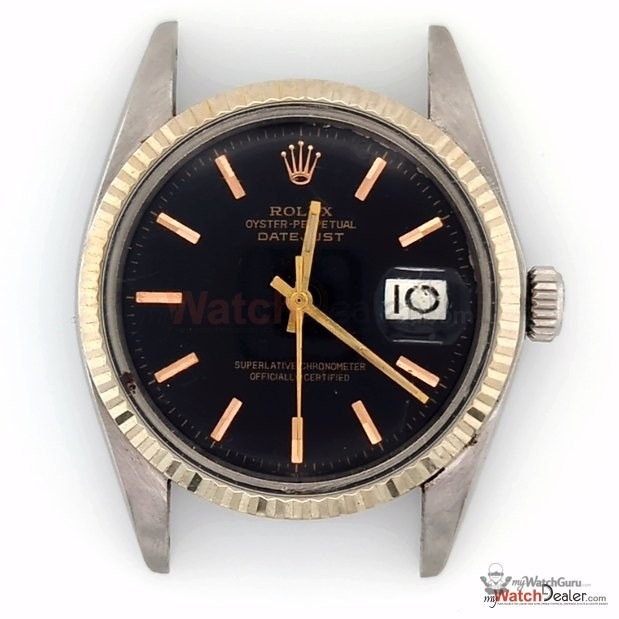
Dating to 1973, the Rolex Datejust 1601 with a black index dial and white gold fluted bezel is also in steel and also head only, with no box or papers. The black dial reads with more contrast than a silver version and ages with a different character over time. The white gold bezel is a factory configuration that surfaces less often than yellow gold, which makes this a slightly less typical example within the reference.
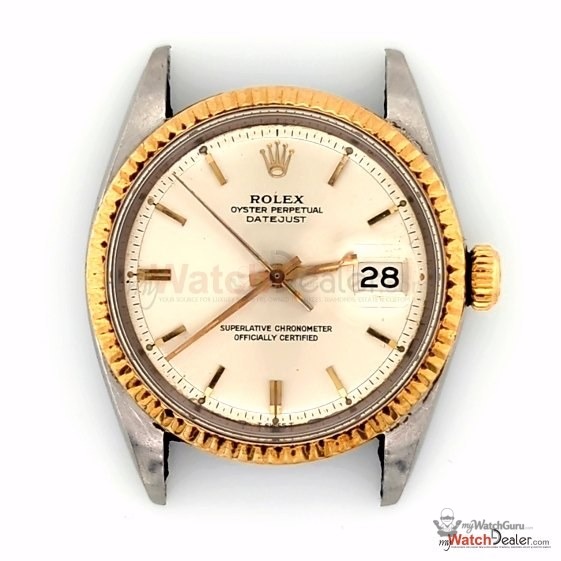
For buyers drawn to a two-tone configuration, the Rolex Datejust 1601 in steel and yellow gold with a silver stick dial is another 1962 piece. The steel and yellow gold case paired with a yellow gold fluted bezel and silver stick dial gives it a warmer tone and more formal feel than the all-steel versions. Like the others, it arrives head only with no box or papers, consistent with what the 1601 market routinely delivers for watches of this age.
Setting realistic expectations before searching makes the process considerably cleaner. The 1601 is widely available precisely because it was produced in large numbers over a long period, and that availability keeps it accessible relative to scarcer vintage Rolex references. Condition on the case and dial matters more than whether papers are present. The non-quick-set caliber is well-understood by watchmakers and thoroughly serviceable, but asking about service history before committing is worth the effort.
Watches from early 1960s production will almost always show case wear. Lugs round off and crown shoulders show wear over time. Dial patina develops across the decades and is generally part of what makes a genuine vintage piece interesting. What matters more is whether a dial has been refinished, which strips original printing and surface texture, or whether the case has been polished so aggressively that the original lines are gone. Replaced hands that don't match the dial era are also worth confirming before purchase, as is the crystal type if originality matters to you.
Well-documented and frequently traded, the 1601 has prices that tend to reflect condition and completeness fairly transparently. That makes it a reasonable reference for a first-time vintage Rolex buyer to learn on.
Sold through My Watch Dealer, our retail desk — full details, current price and purchase all happen there.
View this piece at My Watch Dealer ›