Values & guides
A purpose-built deep diver that sits between the Submariner and the Deepsea, with a helium escape valve and serious water resistance.
The Sea-Dweller was never meant to be the everyday Rolex diver. That role belongs to the Submariner. The Sea-Dweller exists because saturation divers in the late 1960s needed a watch that could survive decompression. When a diver spends days in a pressurized habitat breathing helium-rich gas, helium molecules seep into the case. On ascent, the gas expands faster than it can escape and can pop the crystal off. Rolex, working with the diving firm Comex, solved this with a one-way helium escape valve fitted into the case side. The first Sea-Dweller, reference 1665, arrived in 1967 and carried the now-famous "Sea-Dweller Submariner 2000" text, rated to 610 meters.
That lineage matters when you place the watch in the catalog. The Submariner handles 300 meters and most real-world diving. The Deepsea pushes to 3,900 meters and wears like a slab. The Sea-Dweller is the middle path, currently rated to 1,220 meters, and it remains the model with the most genuine professional history behind it.
Visually the Sea-Dweller reads as a Submariner at first glance, then separates itself on closer inspection. The case is thicker, the crystal is flat and domeless on older references, and the early models had no Cyclops over the date. The crown guards, the unidirectional 60-minute bezel, and the Mercedes hands all carry over from the Rolex diver family. The helium valve at nine o'clock is the quiet tell.
Movement has tracked Rolex's broader upgrades. The 40mm 16600 generation ran the caliber 3135, a workhorse automatic with date. The current 43mm 126600 uses the caliber 3235, which brought the Chronergy escapement and a power reserve near 70 hours. Both carry the Superlative Chronometer rating and the Triplock winding crown. These are robust calibers that handle daily wear and service intervals well.
The 16600, made roughly from 1988 to 2008, is the modern collector's entry point. It kept the classic 40mm case, the flat sapphire crystal, and no Cyclops. We have two examples in this generation, a 1997 and a 2005, both steel on the Oyster bracelet with the black dial and black aluminum bezel. The later production date matters here. The 2005 falls into the period valued for its tritium-free luminous material and tighter finishing, while the 1997 sits at the tail end of earlier dial variants. Either delivers the proportions many buyers consider the sweet spot of the line.
The 126600, launched in 2017 for the model's 50th anniversary, was the big shift. The case grew to 43mm, the Cyclops appeared over the date for the first time on a Sea-Dweller, and the bezel moved to scratch-resistant Cerachrom ceramic. It also revived the red "Sea-Dweller" line on the dial, a nod to the early Double Red examples.
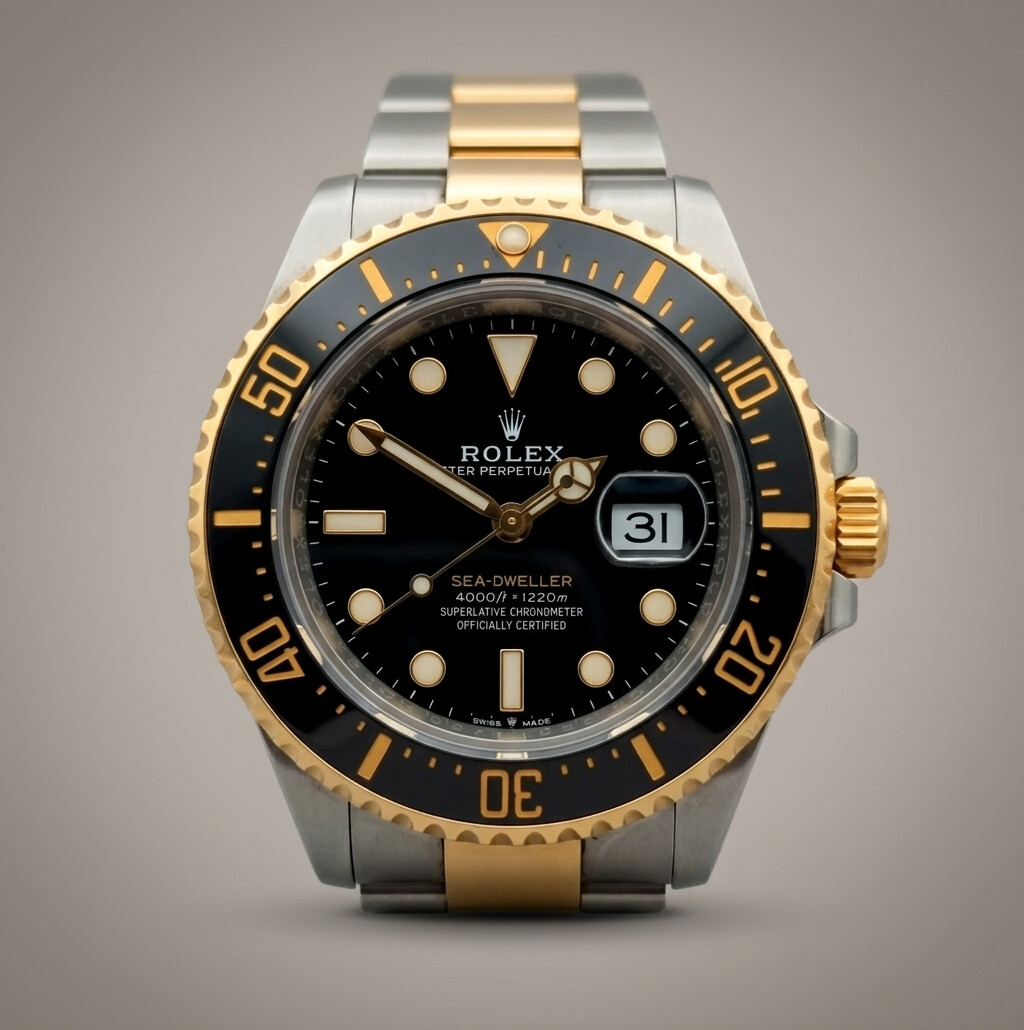
The 126603 is the variant that surprised the purist crowd: steel and yellow gold, what Rolex calls Rolesor. Our example is 43mm with a black dial and black ceramic bezel on the Oyster bracelet. A two-tone professional diver was unusual, but it gives the Sea-Dweller a dress-leaning option without losing the 1,220-meter rating. It suits a buyer who wants one watch that crosses from boardroom to weekend.
This is a watch for someone who wants Rolex diving heritage with more presence than a Submariner and less bulk than a Deepsea. The 16600 appeals to collectors who prefer 40mm cases, no date magnifier, and the cleaner vintage-adjacent look. The 126600 suits buyers with larger wrists or anyone who wants the latest movement and ceramic bezel. The 126603 is for the person who wants luxury and tool credentials in the same package.
It is also a strong choice for buyers who actually go in the water. The screw-down crown, ceramic bezel on current models, and high depth rating are not decorative.
The 40mm 16600 wears true to size and sits flatter than its specs suggest, though it is thicker than a Submariner of the same era. It works under a cuff with effort. The 43mm 126600 and 126603 wear larger and taller. On a wrist under about 6.75 inches the case can feel substantial, so trying one on matters. The Oyster bracelet with the Glidelock or Fliplock extension on newer references adjusts easily over a wetsuit and refines the fit on the wrist day to day. For those who want a sportier setup, aftermarket rubber straps cut for the Sea-Dweller case open up a different look entirely.
Our current Sea-Dweller inventory spans six pieces from roughly $9,150 to $21,750, covering steel 16600 examples at the accessible end and the two-tone 126603 at the top. Discontinued 16600 references trade on condition, dial originality, and box-and-papers completeness. The current 126600 and 126603 hold value well given steady demand. Across the board this is a model that has historically stayed liquid on the secondary market.
Current availability and dealer-direct pricing are at My Watch Dealer.
See current inventory & pricing at My Watch Dealer →