Values & guides
A vintage Tudor built on Rolex hardware, offering Oyster-case durability and honest dressiness without the crown-branded premium.
The Oysterdate sits at the heart of vintage Tudor collecting, and it explains what Tudor was for. Hans Wilsdorf built the brand as Rolex's more attainable sibling. The idea was simple: give buyers the same Oyster case, the same screw-down crown, and the same bracelets that made Rolex famous, then fit a proven third-party movement instead of an in-house calibre. The result was a watch with genuine waterproof credentials at a fraction of the price. Today that logic still holds, which is why a clean Oysterdate remains one of the smartest entry points into mid-century watchmaking.
The Oysterdate name covered Tudor's date-equipped, time-only Oyster models from the 1950s into the 1960s and beyond. It should not be confused with the Oysterdate Chronograph, the racing-inspired Monte Carlo pieces that trade for many multiples of a standard model. The standard Oysterdate was the everyday watch: a dress-leaning, do-everything piece meant to be worn hard and serviced cheaply. It bridged the plain Oyster (no date) and the later automatic Prince Oysterdate models that introduced self-winding movements.
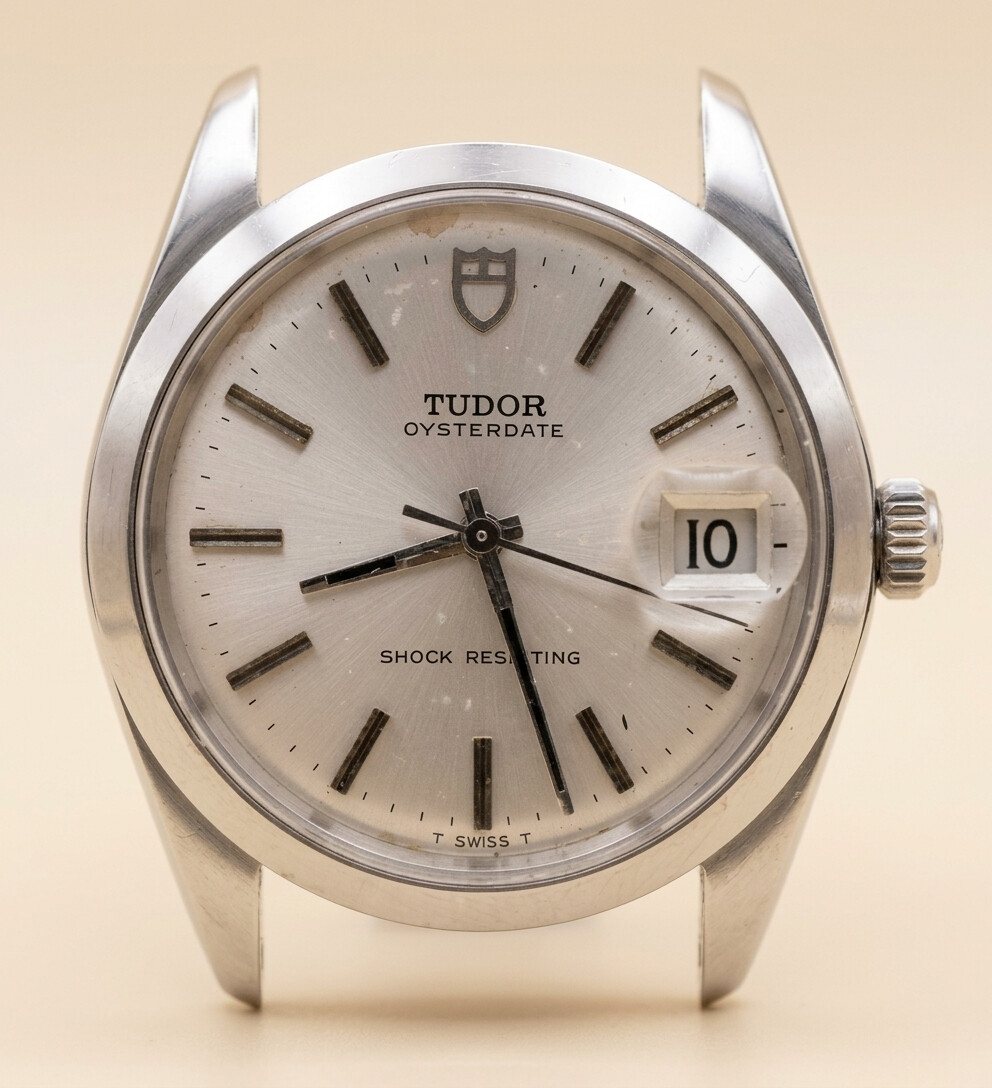
The reference we currently stock, the 7992/0, is a textbook example. It is a 34mm steel case with a silver dial, applied stick markers, and a smooth bezel. The /0 suffix denotes the polished steel finish. It is offered as a head only, which means you buy it without a bracelet and pair it with a strap or source a period-correct Oyster bracelet separately. One is in stock at $1,900.
The case is pure Rolex Oyster architecture: a screw-down crown, a threaded case back, and the flat, tool-like proportions that defined the era. At 34mm it wears as a proper vintage dress watch, sitting flush under a cuff and reading smaller than a modern 40mm sports piece. Lug-to-lug it stays compact, so it suits wrists from roughly 6 to 7.25 inches without overhang. The silver stick dial is the classic configuration, clean and legible, with a date aperture at three. Early examples carry the rose logo; later ones wear the Tudor shield.
Inside, Tudor used manual-wind ETA movements rather than Rolex calibres. That is the whole value proposition. These movements are robust, widely understood, and inexpensive to service, and parts remain available. There is no rotor to wear out and no complicated automatic module to rebuild. For a buyer who wants vintage character without the anxiety of a fragile or unobtainable movement, this is a reassuring place to start.
The Oysterdate family runs across several four-digit references, and the differences are worth knowing before you buy. Case finish is signalled by the suffix: /0 for polished steel, other suffixes for different bezel or metal treatments. Dial variations are where collectors focus. Silver stick dials like the one here are the versatile, understated choice. Other dials appear with different indices, textures, or colours, and condition of the dial drives price far more than the case does. Bezels are typically smooth on the dress references, while sportier Tudors of the period moved toward engine-turned or rotating bezels. When comparing two Oysterdates, check the reference against the crown, the movement, and the dial signature to confirm everything is period-correct and unmolested.
This is a watch for the buyer who values provenance and mechanical honesty over brand flash. It rewards someone getting into vintage for the first time, and it makes a genuine everyday dress watch for a collector who already owns modern pieces. On a leather strap it reads formal and quiet. On an Oyster bracelet it gains a touch of tool-watch attitude. Because our 7992/0 is a head only, you can tailor that character yourself, which many buyers prefer.
Expect the ergonomics of a 1960s watch: a smooth manual wind, a date that changes with a quick set, and a modest water resistance that has almost certainly diminished with age. Treat it as splash-resistant, not a swimmer, and have the case gaskets checked at service.
On value, vintage Tudor has quietly climbed as buyers priced out of vintage Rolex look for the same DNA at a saner number. A clean, honest Oysterdate in the high-$1,000s to low-$2,000s represents fair money, and our example sits right in that band at $1,900. The pieces that hold value best have original dials, correct hands, matched crowns, and unpolished or lightly polished cases.
Before buying, verify the reference on the case back against the movement, inspect the dial for redialing or heavy patina, and confirm the crown is a signed Tudor or Rolex part. Ask when the watch was last serviced. A running, recently serviced Oysterdate with an original dial is the one to own, and it is the kind of watch you can wear for decades and pass on.
Current availability and dealer-direct pricing are at My Watch Dealer.
See current inventory & pricing at My Watch Dealer →